
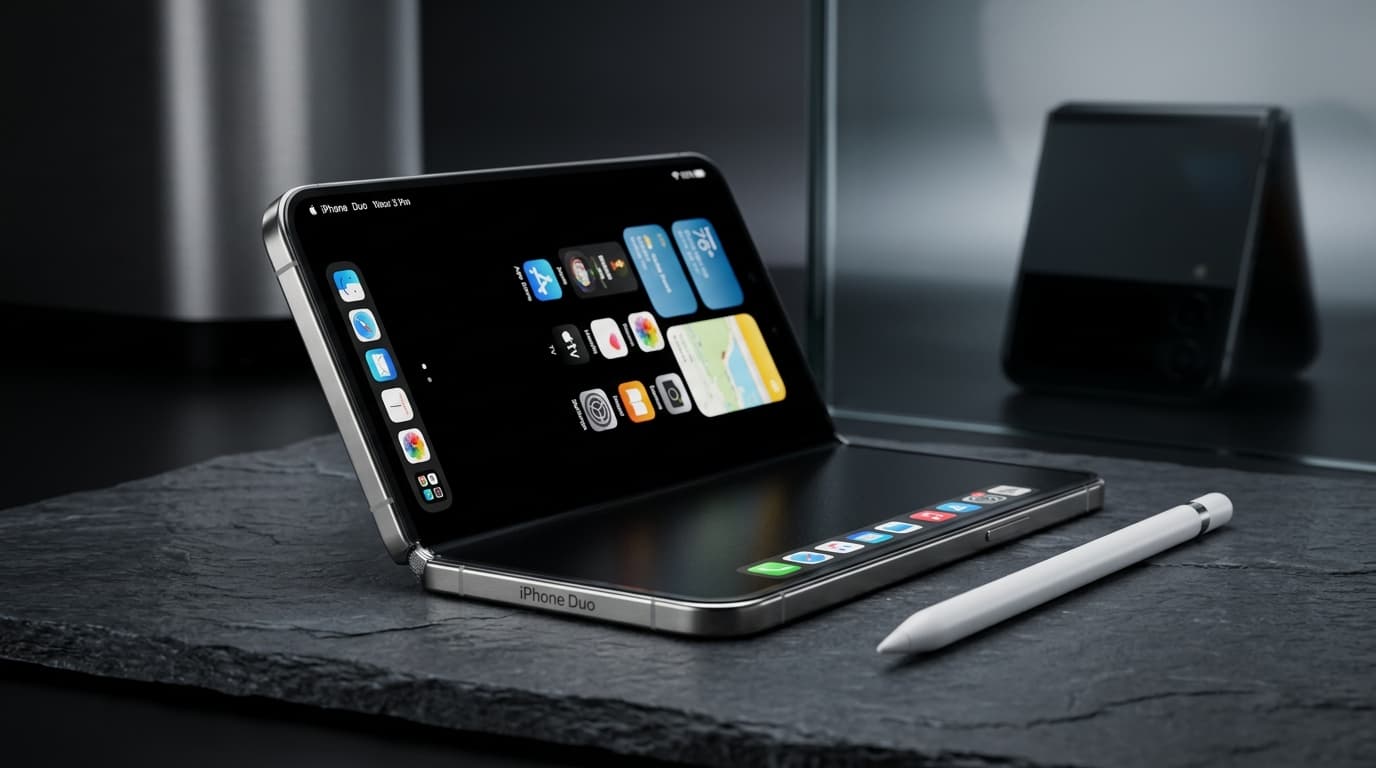
For seven years, Apple watched from the sidelines while Samsung, Google, Huawei, and OnePlus turned flexible OLED displays from fragile prototypes into a legitimate luxury smartphone category. While competitors iterated through six generations of hinges, screen creases, and durability fixes, Cupertino appeared content to let Android absorb the early hardware failures.
On September 9, 2026, that observational era ended.
At Apple’s “Surprise and Shine” keynote, newly minted CEO John Ternus—who succeeded Tim Cook on September 1 after leading Hardware Engineering for years—anchored his first major product event with the company’s biggest hardware transformation since the original iPad: the iPhone Duo.
Starting at $1,999, the iPhone Duo folds into a compact, passport-sized 5.4-inch outer display and opens into a 7.6-inch Super Retina XDR canvas powered by the 2nm A20 Pro system-on-chip. Crucially, it becomes the first iPhone in history to support the Apple Pencil, effectively merging the flagship iPhone with the iPad mini.
For years, Samsung's primary defense in the ultra-premium foldable segment was simple: if you want an 8-inch screen in your pocket, you have to leave iOS. Now that Apple has entered the ring, is Samsung's foldable dominance in existential jeopardy, or has Cupertino just validated the market Samsung built?
The Engineering Breakdown: How Apple Built the iPhone Duo
Apple did not enter the foldable space with an experimental prototype. Backed by John Ternus's mechanical engineering background, the iPhone Duo reflects an obsession with structural tolerances, thermal dissipation, and crease mitigation.
1. The Hinge and the Crease Solution
Rather than relying on a standard single-axis teardrop hinge, Apple engineered a dual-plate mechanism. High-strength ultra-thin glass sits above and below the OLED panel, bound with custom sliding adhesives that allow the internal layers to glide past each other like the pages of a book when bent. Supported by a bottom titanium plate and an integrated magnet array, the inner display opens flat with virtually no visible optical crease, finished with a specialized nano-texture coating that eliminates harsh interior reflections.
2. The Passport Aspect Ratio
Unlike the tall, narrow "candy bar" cover screen that defined early Galaxy Z Fold generations, Apple opted for a wider, passport-inspired form factor. Closed, the 5.4-inch outer display provides a familiar 90% screen area of an iPhone 18 Pro, making one-handed typing natural. Opened, the 7.6-inch canvas provides a balanced square-ish aspect ratio that eliminates awkward black letterboxing in split-screen apps.
3. Apple Pencil Support & Under-Display Optics
The inner display integrates a digitizer layer compatible with the Apple Pencil (USB-C). To preserve an unobstructed digital canvas, Apple eliminated the Dynamic Island on the interior, hiding a 12MP Center Stage camera beneath the display pixels for FaceTime calls. Biometric authentication shifts to a side-mounted Touch ID sensor integrated directly into the titanium power button.
iPhone Duo vs. Samsung Galaxy Z Fold: The Specs Showdown
Samsung has spent seven generations refining the Galaxy Z Fold series, building out mature multitasking features, enterprise partnerships, and display supply chains. Here is how the two heavyweights compare in the 2026 flagship landscape:
| Hardware & Software Vector | Apple iPhone Duo | Samsung Galaxy Z Fold (Flagship Gen) | Strategic Advantage |
|---|---|---|---|
| Starting Price (Base) | $1,999 (256GB / 512GB / 1TB / 2TB) | $1,899 – $1,999 (256GB / 512GB / 1TB) | Tie on pricing tiers. |
| Cover Display | 5.4-inch Super Retina XDR (3,000 nits peak, Ceramic Shield 2) | 6.3-inch Dynamic AMOLED 2X (Tall aspect ratio, 2,600 nits) | iPhone Duo for one-handed pocketability; Samsung for screen height. |
| Inner Folding Display | 7.6-inch Foldable OLED with Nano-Texture anti-glare finish | 7.6-inch Dynamic AMOLED 2X with Ultra-Thin Glass (UTG) | iPhone Duo wins on glare reduction and minimal crease reflection. |
| SoC & Process Node | Apple A20 Pro (TSMC 2nm) + Vapor Chamber | Snapdragon 8 Gen 5 / Exynos Flagship (3nm) | Apple leads in single-thread compute and watt-efficiency. |
| Multitasking OS | iOS 27.1 (Dynamic Stage Manager, App Pairs, Sidecar) | One UI + Samsung DeX (Up to 4 apps split, floating pop-ups, desktop mode) | Samsung retains deeper desktop-style window flexibility. |
| Stylus Input | Apple Pencil (USB-C) supported (Sold separately) | S Pen Fold Edition supported (Case/slot accessories) | Tie; S Pen is thinner, but Apple Pencil carries broader creative app support. |
| Camera Hardware | Dual 48MP Fusion (Wide + Ultra Wide with 2x optical crop); 4K 120fps | Triple Camera (50MP Wide + 12MP Ultra Wide + 10MP 3x Optical Telephoto) | Samsung wins on physical telephoto reach; Apple on video fidelity. |
| Biometrics | Side-mounted Touch ID + Apple Watch Auto-Unlock | Side-mounted Capacitive Fingerprint Scanner | Tie (Both drop complex 3D facial hardware). |
Is Samsung in Trouble? Three Market Realities
The narrative that "Apple enters, Samsung dies" is a perennial tech-media cliché. But the reality of consumer hardware shifts in 2026 is far more nuanced.
1. The High-End Defection Threat Is Real
For the past three years, Samsung’s most lucrative conquest demographic consisted of wealthy iPhone users who bought a Galaxy Z Fold as a second device or reluctantly switched to Android because they wanted a pocket tablet for reading documents, trading, and media consumption.
That demographic is gone for Samsung. The moment pre-orders open on October 16, every iOS power user who tolerated Android just to get a folding screen will migrate back to their native ecosystem, reconnecting their Apple Watch Ultra, iCloud photo library, and iMessage group chats.
2. The "Category Legitimization" Paradox
Whenever Apple enters a hardware category late, it rarely kills the incumbent immediately—instead, it expands the entire market pie.
- In 2010, critics claimed the iPad would kill Android tablets. Instead, it turned tablets into a 150-million-unit annual industry.
- In 2015, the Apple Watch didn't kill wearable tech; it turned fitness trackers into standard consumer equipment.
Samsung currently manufactures the folding OLED substrates used across the global supply chain. Ironically, as an upstream component supplier via Samsung Display, Samsung will make billions of dollars selling display panels and memory modules to Apple for the iPhone Duo. While Samsung Electronics faces brutal retail competition, Samsung's corporate bottom line will benefit from Apple driving foldables into mainstream consumer awareness.
3. Samsung's True Vulnerability: Chinese Hardware Innovation
Samsung’s real headache isn't just Cupertino—it is the dual-front war it faces. While Apple takes the ultra-luxury $2,000+ segment, Chinese manufacturers like Honor, Xiaomi, and Huawei have spent the last two years releasing foldables that are thinner, lighter, and pack larger silicon-carbon batteries than the Galaxy Z Fold.
If Samsung remains caught in the middle—slower to adopt thin-profile hardware than Chinese competitors, and lacking the operating-system prestige of Apple—its margins in the premium category will face immense pressure.
The Developer Playbook: Building for the Foldable iPhone
For iOS developers, software engineers, and product designers, the launch of the iPhone Duo breaks the assumption that an iPhone screen is a static, vertical rectangle.
-
Adopt SwiftUI Adaptive Geometry & Content Continuums: Layout Architecture. Do not build separate apps for folded and unfolded modes. Use SwiftUI’s
ViewThatFitsand adaptive grid layouts (LazyVGrid) that listen to window dimension changes dynamically, ensuring smooth continuity when the user unfolds the device mid-session. -
Optimize for Square-Aspect Ratios (4:3 and 1:1): Aspect Handling. The 7.6-inch inner display approaches a boxy aspect ratio. Audit your apps for media scaling: ensure wide 16:9 video feeds don't clip captions, and refactor scrollable feeds into dual-pane master-detail views when unfolded.
-
Integrate PencilKit Annotations on Canvas Elements: Pencil Interaction. With the iPhone Duo supporting the Apple Pencil (USB-C), wire
PKCanvasViewinto document viewers, notes apps, and PDF workflows. Users will expect instant, low-latency markups on an iPhone for the first time. -
Implement Duo Preview Multi-Screen APIs: Camera Switching. Leverage AVFoundation’s updated APIs for dual-screen capture. Allow the photographer to frame a portrait shot on the inner canvas while projecting a live "Duo Preview" feed onto the 5.4-inch outer display for the subject.
The Horizon: The John Ternus Era Begins
The launch of the iPhone Duo marks a pivotal changing of the guard in Cupertino.
Under Tim Cook, Apple became a three-trillion-dollar logistical powerhouse that prioritized supply-chain precision, services expansion, and incremental, risk-averse device updates.
By kicking off his tenure with the iPhone Duo, John Ternus has signaled that Apple is once again willing to take bold, mechanical hardware risks.
Samsung is not dead—its foldable foundation is too deep, its carrier distribution is too entrenched, and its mid-range Flip lineup remains untouched. But the era of uncontested Android foldable supremacy is officially over.
The battle for the pocket computer has been redefined: not as a debate over whether phones should fold, but over which operating system can turn a folding slab of glass into a true computing platform.