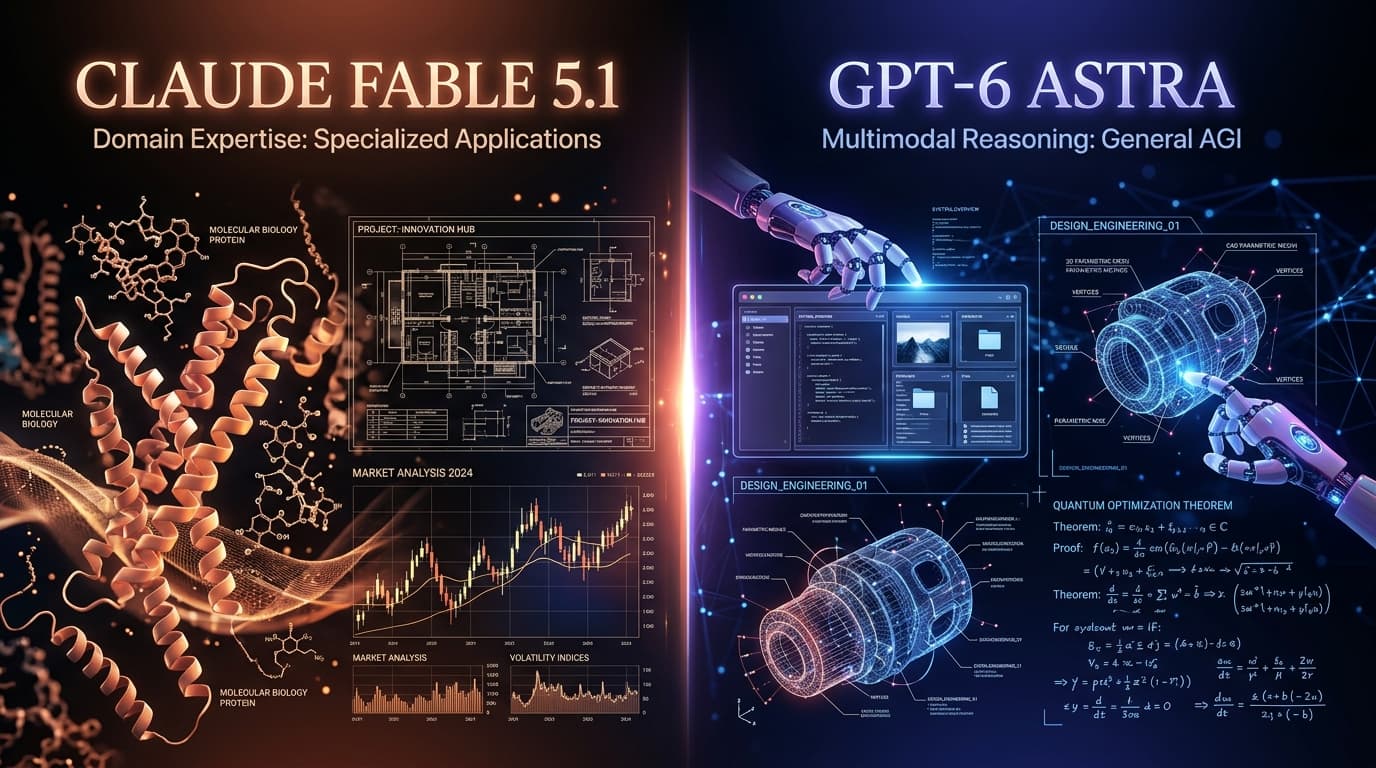
When Anthropic launched Claude Fable 5.1 on September 1, 2026, followed forty-eight hours later by OpenAI’s GPT-6 Astra on September 3, the artificial intelligence landscape entered its sharpest architectural standoff to date. Both models share an identical base API sticker price—$10 per million input tokens and $50 per million output tokens—and both target autonomous coding, long-horizon agents, and scientific reasoning.
Yet, evaluating them purely through vendor-selected launch slides produces a contradictory picture. OpenAI boasts of breakthrough scores on FrontierMath (97.6%) and OSWorld 2.0 (72.6%), while independent evaluations from Artificial Analysis place Claude Fable 5.1 ahead on both the Coding Agent Index (70 vs. 67) and the broader Intelligence Index (66 vs. 61).
Moving beyond synthetic benchmarks into live developer environments reveals that these two engines are optimized for fundamentally different types of work.
The Head-to-Head Scorecard
| Dimension | Claude Fable 5.1 (Anthropic) | GPT-6 Astra (OpenAI) | Practical Engineering Verdict |
|---|---|---|---|
| Coding & PR Mergeability | Surgical & Idiomatic. 70 on Artificial Analysis Coding Agent Index; minimal diffs, zero stylistic churn, passes team reviews. | Dense & Algorithmic. 67 on Coding Agent Index; writes compact diffs but frequently refactors adjacent unrequested modules. | Fable 5.1 for production repositories; Astra for greenfield scripting and algorithmic heavy-lifting. |
| Debugging & Root Cause | Root-Cause Focus. Traces upstream state side-effects; fixes underlying bugs rather than patching symptoms. | Relentless Trial-and-Error. Rapidly iterates through terminal executions until compilers stop complaining. | Fable 5.1 finds the true architectural bug; Astra gets broken code compiling faster. |
| Computer Use & GUI | DOM & Browser Heavy (70.2% OSWorld 2.0). Methodical web automation; slower frame capture cadence. | Native Desktop OS Driver (72.6% OSWorld 2.0). Fluid screen navigation across macOS, Linux, and multi-app windows. | Astra dominates desktop and multi-app GUI workflows. |
| Terminal & Shell Mastery | 55.8% on Terminal-Bench 4.0; strong, but more conservative with destructive commands. | 57.9% on Terminal-Bench 4.0. Exceptional low-level bash manipulation, container troubleshooting, and network triage. | Astra is the superior automated DevOps engineer. |
| Research & Science | 65.0% on Humanity's Last Exam (tools). State-of-the-art biological binder design; exceptional financial trading intuition. | 57.2% on HLE; 97.6% on FrontierMath Tier 4. Superior formal mathematics, CAD geometry, and physics calculations. | Fable 5.1 for multidisciplinary science and finance; Astra for pure mathematics and CAD. |
| Prompt Cache Economics | $0.25 / 1M cached tokens (75% price cut). Reduces total cost of agentic workloads by up to 45%. | $1.00 / 1M cached tokens. Standard 90% discount on inputs, but 4x more expensive than Fable's cache reads. | Fable 5.1 is vastly cheaper for long-running, multi-turn agent loops. |
| Context & Output Capacity | 1,000,000 tokens context; 128,000 output tokens. | 1,050,000 tokens context; 128,000 output tokens. | Tie on raw capacity. Fable 5.1 retains tighter multi-hop attention past 400K tokens. |
1. Coding: The Mergeability Test
In modern software development, raw code generation is commoditized. The true bottleneck is pull request confidence: Can a human lead merge the AI's pull request without spending an hour verifying that it didn't break backward compatibility?
Early developer testing highlights a consistent distinction:
- Claude Fable 5.1 prioritizes architectural restraint. In Claude Code, it analyzes the repository's existing linters, type conventions, and directory structures. When fixing a backend resolver, it modifies only the targeted lines, retains existing comments, and infers implicit requirements (such as edge-case pagination and schema validation) without explicit hand-holding.
- GPT-6 Astra prioritizes algorithmic density. In OpenAI Codex, Astra uses approximately 33% fewer output tokens than previous models. It plans silently using recurrent depth reasoning and emits compact diffs. However, it frequently displays what developers call "architectural restlessness"—renaming helper methods, introducing new utility libraries, or rewriting clean code in adjacent files.
If you evaluate purely on whether a standalone algorithm runs, Astra often ties or edges out competitors. But on the metric of "would I actually merge this into main without rewriting it," developer consensus favors Fable 5.1.
2. Debugging: Symptom Patching vs. Root-Cause Analysis
How a model behaves when an integration test fails separates superficial assistants from genuine engineering tools:
Fable 5.1 was tuned specifically to resist "easy-seeming shortcuts." When a unit test throws a timeout, Fable inspects the entire asynchronous lifecycle to determine whether an unhandled promise rejection or database deadlock occurred upstream.
Astra approaches debugging like an elite penetration tester or systems administrator. It executes bash commands, queries system sockets, inspects Docker container bindings, and adjusts environment variables.
If the problem is an obscure environmental breakage—like a glibc mismatch or a missing shared library—Astra solves it in seconds. But if the problem is a subtle logical flaw buried inside a complex state machine, Astra is more prone to wrapping the error in defensive null-checks rather than resolving the core architectural flaw.
3. Long-Context Repository Work & Multi-File Architecture
Both models feature massive memory footprints—Fable 5.1 with 1,000,000 tokens and Astra with 1,050,000 tokens, both paired with a 128K maximum output buffer.
The divergence lies in attention retention across deep contexts:
- Fable 5.1's Attention Density: On the Artificial Analysis Long-Context Reasoning (AA-LCR) evaluation, Fable 5.1 scores 85.3%. When ingesting a 600,000-token repository, it tracks variable scopes across dozens of directories with minimal attention degradation. In real-world enterprise deployments, trading firms like Jane Street noted that Fable 5.1 remains structurally readable and logically anchored over multi-day, multi-step asynchronous runs.
- Astra's Prefill Overhead: Astra handles large contexts cleanly, but cold queries on 500K+ token payloads incur heavy prefill latency (often 30 to 60 seconds before token emission begins). While it retrieves isolated data points accurately, complex multi-hop dependencies spanning the middle of massive context blocks suffer from noticeable attention dilution compared to its performance on sub-200K prompts.
4. Research, Science, and Complex Knowledge Work
In high-level academic, financial, and scientific tasks, the models split cleanly along domain lines:
- Life Sciences & Multidisciplinary Reasoning: Fable 5.1 (alongside its restricted sibling Mythos 5.1) established state-of-the-art results in molecular design. When paired with open-source folding tools, it achieved a ~50% hit rate designing viable high-affinity protein binders across 12 biological targets—nearly triple standard industrial baselines. On Humanity's Last Exam (HLE) with tools, Fable leads Astra 65.0% to 57.2%.
- Mathematics & Spatial Design: Astra is a mathematical powerhouse. Scoring 97.6% on FrontierMath Tier 4 (versus 87.8% for Fable 5.1), Astra solves doctoral-level mathematical proofs with formal verification precision. Furthermore, on benchmarks like BenchCAD and 3D scene generation (Blender/Unreal Engine), Astra generates structured, editable parametric hierarchies rather than flattened assets.
5. Autonomous Agents and Computer Use
In unguided, autonomous execution, the competition centers on environmental control versus procedural safety:
-
Select Based on the Operating Environment: Desktop vs Browser. Deploy GPT-6 Astra for workflows requiring native desktop interaction. Scoring 72.6% on OSWorld 2.0, Astra navigates multi-window desktop applications, terminals, and un-instrumented system utilities fluidly. Deploy Claude Fable 5.1 for browser-centric tasks, Slack automation (via Claude Tag), and structured web DOM manipulation.
-
Evaluate Task Longevity and Boundary Adherence: Drift Management. For multi-hour, unattended autonomous sessions, Fable 5.1 maintains stricter adherence to system constitutions (
.cursorrules,SKILL.md), rarely deviating from predefined project guidelines. Astra will aggressively rewrite rules or write custom helper scripts to bypass hurdles, requiring strict container sandboxing. -
Audit Operational Failure Rates: Safety Safeguards. In internal computer-use safety evaluations measuring unintended or destructive actions, OpenAI reported an Astra failure rate of 2.4%, compared to 9.5% for Fable 5.1. Astra’s visual grounding reduces mis-clicks on active OS surfaces.
6. The Economics: Why Cache Reads Change the Equation
While both providers list their standard API rates at $10.00 / 1M input and $50.00 / 1M output, Anthropic altered agent economics by slashing prompt cache reads to $0.25 per million tokens (a 75% reduction from previous generations).
In an autonomous agent workflow, the agent does not start with a blank context every turn. It reads an 80,000-token repository context repeatedly as it tests code, checks outputs, and iterates over 30 to 50 turns.
- On Astra, reading that warm 80K cache across 40 turns costs $3.20.
- On Fable 5.1, reading the exact same warm cache costs $0.80.
For highly agentic pipelines where context is cached and reused continuously, Fable 5.1 operates at a 25% to 45% lower net operational invoice than Astra. Astra partially offsets this on raw output generation by emitting fewer output tokens, but for context-heavy agent swarms, Anthropic’s aggressive cache pricing creates a significant economic advantage.
The Verdict: Which Model Should You Use?
Neither model claims a total monopoly across the frontier. The choice between Claude Fable 5.1 and GPT-6 Astra depends strictly on the structural nature of your workload:
Choose Claude Fable 5.1 if:
- You are working inside established, production codebases where clean diffs, backward compatibility, and adherence to team conventions are mandatory.
- You are building long-running autonomous agent loops that rely heavily on prompt caching to keep API overhead sustainable.
- Your domain involves life sciences, protein design, financial market intuition, or deep multidisciplinary research.
- You need deep root-cause debugging on asynchronous system architectures rather than quick syntax fixes.
Choose GPT-6 Astra if:
- Your workflow requires autonomous computer use, operating directly across desktop software, complex terminal environments, and multi-window GUIs.
- You are tackling research-grade mathematics, formal logic proofs, or parametric CAD and 3D scene generation.
- You need an automated DevOps and cybersecurity troubleshooter capable of diagnosing low-level compiler errors, Linux kernel issues, or zero-day vulnerabilities.
- You value one-shot visual and motion generation (such as layered web layouts or programmatic video assemblies) where Astra's internal reasoning planning minimizes manual iterations.