Closed-frontier artificial intelligence labs spent the opening days of September 2026 attempting to establish an unassailable moat. Between OpenAI’s staged rollout of GPT-6 Astra, Anthropic’s gated restrictions on Claude Mythos 5.1, and Google’s continuous Gemini iterations, the narrative was clear: frontier intelligence is too vast, too expensive, and too dangerous for open weights.
On September 10, 2026, DeepSeek dismantled that narrative with the release of DeepSeek V4.1 Flash.
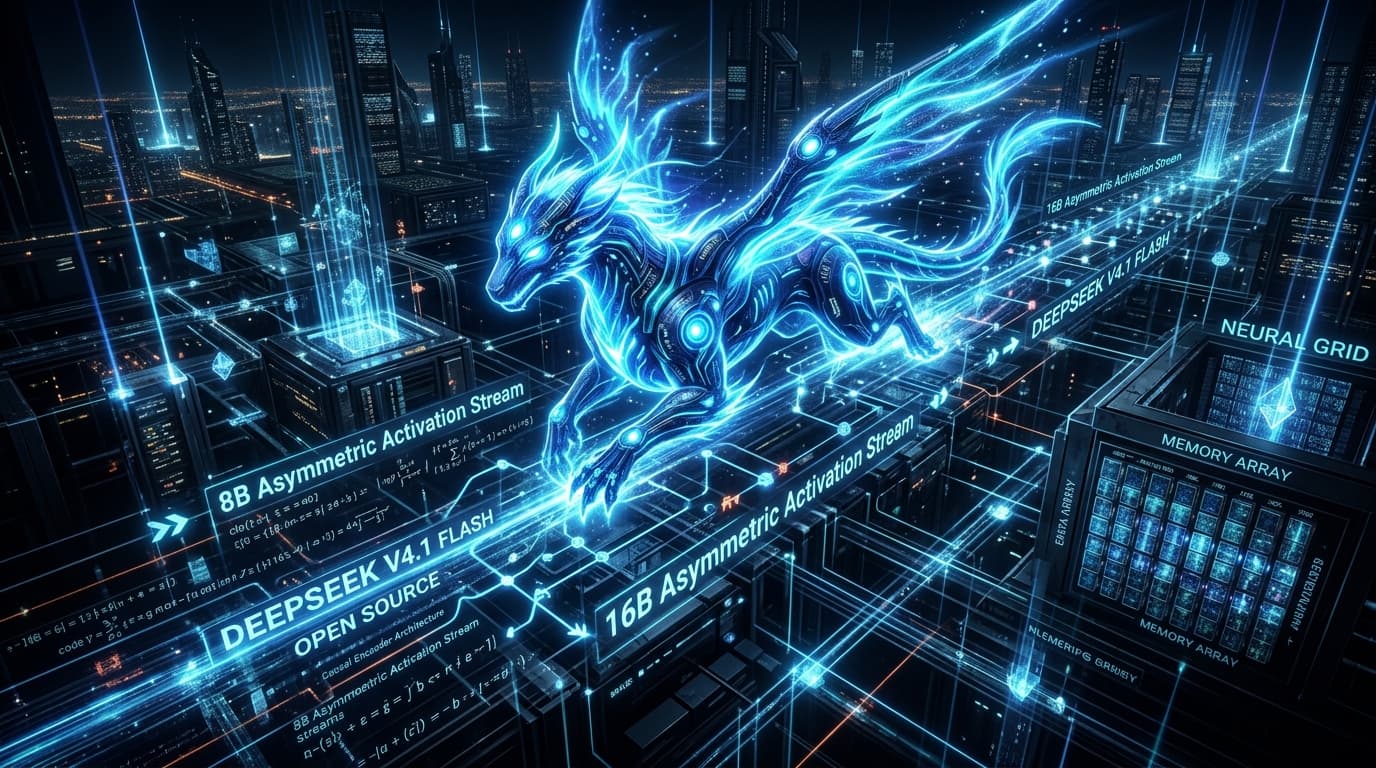
Shipped under an unrestricted MIT License on Hugging Face alongside inference recipes for vLLM, DeepSeek V4.1 Flash is an open-weight, multimodal Mixture-of-Experts (MoE) engine with a 552-billion-parameter backbone. More importantly, it introduces a radical architectural departure from standard dense transformers: a Causal Encoder-Decoder (CED) setup that activates only 8 billion parameters during prompt prefill and 16 billion parameters during generation.
Scoring 90.6 on Terminal-Bench 2.1 (surpassing GPT-5.6 Sol at 88.8) and matching Claude Opus 5 on DeepSWE v1.1, DeepSeek priced its hosted API at an astonishing $0.15 per million input tokens and $0.60 per million output tokens.
The open-source AI ecosystem isn't trailing closed labs by six months anymore. In fundamental systems architecture, memory compression, and inference efficiency, it is actively setting the pace.
The Architectural Breakthrough: Causal Encoder-Decoder (CED) & 1GB KV Caches
Most modern LLMs rely on decoder-only transformer architectures. When you feed a 500,000-token codebase into a decoder-only model, every layer must compute and store Key-Value (KV) cache tensors for every token, causing memory usage to explode.
DeepSeek V4.1 Flash bypasses this bottleneck by splitting its 40 transformer layers into a 20-layer causal encoder followed by a 20-layer decoder:
- The 8B / 16B Asymmetric Activation: During the prompt ingestion (prefill) phase, only the encoder runs, activating just 8 billion parameters per token. The decoder only engages during generation, routing through 16 billion active parameters. This asymmetric split keeps computational throughput extraordinarily high.
- Compressed Global KV Cache (~890 Bytes/Token): Instead of storing separate KV states across all 40 layers, the decoder’s global KV cache is projected directly from the encoder’s final hidden state. The result: a full 1-million-token context window consumes under 1 GB of VRAM for its global KV cache—roughly one-quarter the cache footprint of previous Flash models.
- Engram N-Gram Memory: Layers 1 and 14 integrate massive lookup hash tables containing 196.6 billion parameters of static n-gram associations. These tables handle deterministic language patterns without burning dynamic expert capacity.
- DSpark Multi-Token Drafting: Replacing traditional Multi-Token Prediction (MTP), V4.1 Flash uses a 3-stage speculative draft head that proposes blocks of 5 tokens simultaneously, pushing average inference speeds past 138 to 175 tokens per second.
The Local Developer Reality: Can You Actually Run It?
The term "Flash" can be misleading. While V4.1 Flash only activates 8B to 16B parameters per token, the model’s total weight footprint remains 552 billion parameters (plus the 196B Engram memory tables).
Even with DeepSeek’s mixed MXFP4/MXFP8 quantization, loading the raw un-pruned checkpoint requires specialized infrastructure—typically an 8x H100/H200 cluster or multi-GPU enterprise nodes running vLLM Docker containers.
For solo developers, independent hackers, and workstation engineers, this raises a crucial question: Where does DeepSeek fit against the models you can actually boot locally on your machine?
Local AI Shootout: DeepSeek vs. Qwen vs. Gemma vs. Llama
For engineers building on sovereign hardware, the open-weights ecosystem in 2026 has differentiated into four distinct powerhouses:
| Model Family | Key Local Variants | Architecture & Licensing | Sweet Spot for Local Developers | Weaknesses & Trade-Offs |
|---|---|---|---|---|
| DeepSeek (V4.1 Flash / Distills) | 552B MoE (8B/16B act), 14B/32B Distills | MIT License; Causal Encoder-Decoder (CED), MoE | Inference Architecture & Economics. Unbeatable API cost ($0.15/$0.60) for long-horizon agent runs and automated testing. | Full 552B weights cannot run on consumer laptops; local use requires GGUF distills. |
| Qwen (Alibaba) (Qwen 2.5 / 3 / Coder) | 7B, 14B, 32B, 72B | Apache 2.0; Dense Transformer + MoE | The Undisputed Local Coding King. 14B and 32B Coder variants run natively on consumer RAM with class-leading syntax & terminal tool calling. | Requires strict system prompting to prevent excessive conversational preamble. |
| Gemma (Google) (Gemma 2 / 3) | 2B, 9B, 27B | Permissive Open Terms; Dense with heavy distillation | Raw Parameter Density. 9B punches well above its weight in mathematical reasoning and logic; extremely efficient memory-to-IQ ratio. | Smaller context windows (8K–32K on older builds); more rigid refusal alignment. |
| Llama (Meta) (Llama 3.1 / 3.3 / 4) | 8B, 70B | Llama Community License; Dense Foundation | Ecosystem Bedrock. Unmatched fine-tuning stability, massive community tooling, universal Ollama/llama.cpp support, and wide context (128K). | 8B lags behind Qwen-Coder on complex multi-file code refactors; 70B requires 40GB+ RAM. |
From the Workstation Trenches: The Multi-Agent Reality Check
Sitting at my workstation late into the night in Central Sri Lanka—balancing Information Technology degree modules specializing in Artificial Intelligence at SLIIT with real-world software builds—the release of DeepSeek V4.1 Flash illustrates how fast the open ecosystem is moving.
On my primary development setup (an MSI Cyborg laptop upgraded with 28GB of high-speed DDR5 RAM), I rely entirely on a decoupled, sovereign multi-agent development grid via Ollama and OpenClaw. The architecture distributes tasks across three specialized digital personas:
- Hana (Architecture & Research): Synthesizes documentation, evaluates system requirements, and writes specifications.
- Zero (Execution & Code Refactoring): Traverses directory trees, executes refactoring diffs, and runs local terminal commands.
- Sakura (Workflow & State Management): Serves as the orchestration graph, managing context state handoffs and memory boundaries between Hana and Zero.
On a 28GB memory ceiling, running a raw 552B model locally is a physical impossibility. But this is where the modern hybrid open-stack shines:
Zero runs locally on Qwen 2.5-Coder 14B (Q5_K_M) directly inside system RAM. It handles 85% of daily tasks—writing unit tests, checking TypeScript typings, and executing bash commands—at zero cost and with zero latency.
When a task requires ingesting an entire 400,000-token repository history or running a 60-turn continuous regression scan, the orchestration layer escalates the payload to DeepSeek V4.1 Flash. Because V4.1 Flash costs a mere $0.15 per million tokens, running a multi-turn agentic scan costs two cents instead of the five dollars it would demand on proprietary cloud models.
The Developer Playbook: Setting Up the Open Stack in 2026
If you want to build a resilient, cost-effective development environment that leverages the best of local silicon and open-weight architectures, follow this implementation roadmap:
- Deploy Qwen-Coder and Gemma via Ollama: Local Foundation.
Install Ollama and pull quantized checkpoints tailored to your hardware headroom. On 16GB–32GB RAM workstations, deploy
qwen2.5-coder:14b-instruct-q5_k_mfor code generation andgemma2:9bfor concise reasoning:
ollama run qwen2.5-coder:14b-instruct-q5_k_m
-
Configure OpenClaw / vLLM API Endpoints: Gateway Configuration. Set up your agent orchestrator to expose an OpenAI-compatible routing gateway. Bind your local Ollama port (
localhost:11434/v1) as Tier-1 and configure a remote DeepSeek V4.1 Flash endpoint (via OpenRouter or a self-hosted vLLM instance) as Tier-2. -
Enable CED and Sliding-Window Attention Parameters: KV Cache Optimization. When serving DeepSeek V4.1 Flash or its distilled variants on remote instances via vLLM, ensure the Docker image is updated to support the Causal Encoder-Decoder kernel and the DSpark speculative drafting head:
docker run --gpus all vllm/vllm-openai:deepseekv41-flash-0909 \
  --model deepseek-ai/DeepSeek-V4.1-Flash \
  --speculative-model dspark-draft-head
- Isolate Multi-Agent Personas with Scoped Tasks: Agent Memory Partitioning. Keep your local models sharp by enforcing strict persona boundaries. Task your local research agent with generating small, deterministic JSON specs before passing the execution tokens to your coding agent, avoiding context bloating.
The Horizon: Open Weights Are Winning the Economics
DeepSeek V4.1 Flash confirms a permanent shift in artificial intelligence: the economic advantage in AI systems engineering has decisively shifted toward open architectures.
Closed labs are trapped in an escalating cycle of capital expenditure—building multi-hundred-billion-dollar data centers to run massive, dense models that they must gate behind $50-per-million-token paywalls and restrictive access queues.
Meanwhile, open-weight researchers are doing what open-source software has always done best: relentlessly optimizing the underlying computer science.
By introducing Causal Encoder-Decoder architectures, shrinking KV caches to under a gigabyte, and releasing weights under MIT licenses, DeepSeek, Qwen, and Meta are ensuring that the future of computing will not be leased from a handful of cloud landlords.
The models are getting lighter, the execution loops are getting faster, and the open-source community is just getting started.