
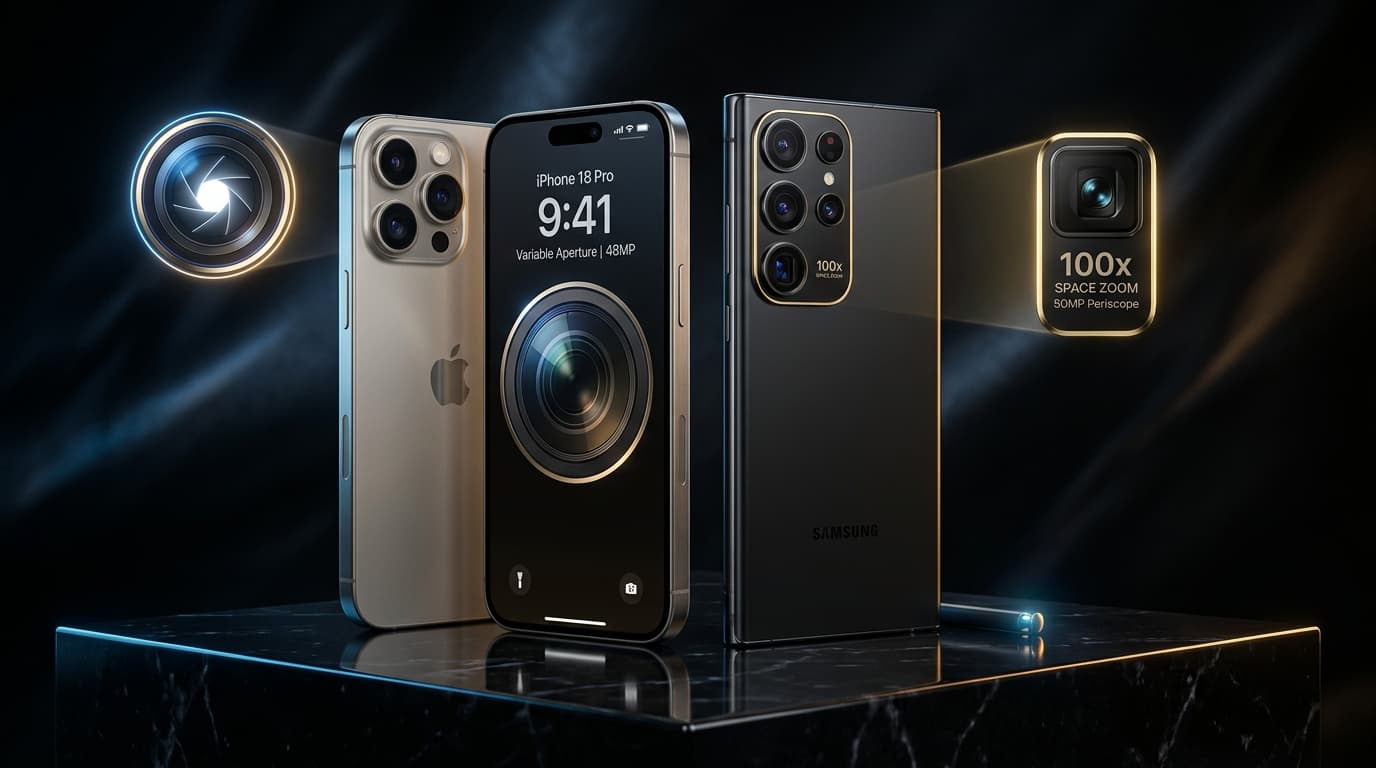
While Apple’s folding iPhone Duo captured the early launch-event headlines, the real battle for the soul of the mobile industry is happening in the pocket-sized flagship tier.
With the release of the iPhone 18 Pro (powered by the 2nm A20 Pro chip and an industry-first mechanical variable-aperture camera) and Samsung’s powerhouse Galaxy S26 Ultra (anchored by the Snapdragon 8 Elite Gen 5 and a 200MP quad-camera array), the battle lines for 2026 are drawn.
This isn't just a spec sheet comparison of megapixels and gigahertz. It is a clash between two fundamentally opposing philosophies of mobile computing: Apple’s tightly integrated, on-device AI ecosystem versus Samsung and Google’s flexible, multimodal agentic grid.
The Head-to-Head Flagship Scorecard
| Hardware & AI Vector | Apple iPhone 18 Pro | Samsung Galaxy S26 Ultra | Strategic Winner |
|---|---|---|---|
| Starting Price | $1,199 (256GB base) | $1,299 (256GB base) | iPhone 18 Pro ($100 cheaper base) |
| Processor & Node | Apple A20 Pro (TSMC 2nm) + 32-core Neural Engine | Snapdragon 8 Elite Gen 5 (3nm class) + AI-ISP | Apple wins on raw process node efficiency and memory bandwidth. |
| RAM & Storage | Up to 2TB storage; 50% higher memory bandwidth | Up to 16GB RAM; up to 1TB storage | Samsung for raw RAM capacity; Apple for storage ceiling (2TB). |
| Main Camera Tech | 48MP Fusion Main with Mechanical Variable Aperture (ƒ/1.48 to ƒ/4.0) | 200MP Wide Main (ƒ/1.4) + advanced AI multi-frame fusion | Tie. Apple wins on physical optical control; Samsung on raw sensor resolution. |
| Telephoto Zoom | 4x Tetraprism (100mm) + 8x optical-quality crop (200mm); 40x digital | 3x (10MP) + 5x (50MP periscope); up to 100x Space Zoom | Samsung wins on extreme distance range (100x); Apple on mid-telephoto sharpness. |
| On-Device AI & Siri | Next-Gen Apple Intelligence; context-aware screen awareness & 3,000+ app intents | Galaxy AI (Now Nudge, Call Screening, Document Scan) + Gemini / Perplexity | Samsung leads in flexible multi-assistant options; Apple on native OS integration. |
| Hardware Privacy | Encrypted Secure Enclave + private cloud compute | Built-in Privacy Display (hardware-level pixel masking for side angles) | Samsung wins on physical anti-peeking display tech. |
| Battery & Charging | Up to 33–34 hours video playback; enhanced vapor chamber cooling | 5,000 mAh; Super Fast Charging 3.0 (60–65W wired, 75% in 30 mins) | Samsung wins decisively on wired charging speeds. |
1. The Camera War: Mechanical Aperture vs. Megapixel Brute Force
For years, smartphone cameras relied on computational photography algorithms to fix the limitations of fixed-aperture miniature lenses. In 2026, both Apple and Samsung pushed past software-only tricks, but they took diametrically opposed engineering routes.
Apple iPhone 18 Pro: The Mechanical Variable Aperture
Apple integrated a true mechanical variable aperture into the 48MP Fusion Main camera. Using six laser-cut mechanical blades, the lens physically shifts between four distinct stops—ƒ/1.48, ƒ/1.8, ƒ/2.8, and ƒ/4.0.
- In low light, it drops to ƒ/1.48 to flood the 2nd-generation sensor-shift OIS with light.
- For group shots or landscapes where edge-to-edge sharpness matters, it steps down to ƒ/4.0, eliminating the artificial-looking blur that portrait modes often introduce to background subjects.
Samsung Galaxy S26 Ultra: The 200MP Multi-Focal Powerhouse
Samsung doubles down on its undisputed leadership in physical zoom reach. The S26 Ultra pairs a massive 200MP main sensor (ƒ/1.4) with a dual-telephoto arrangement: a dedicated 3x portrait lens and a 50MP 5x periscope telephoto that stretches cleanly out to 100x Space Zoom. Backed by a new AI Image Signal Processor (AI-ISP), Samsung's "Nightography" engine reduces motion blur and noise in pitch-black environments more aggressively than Apple's pipeline.
2. The AI Engine: Siri Integration vs. Galaxy AI Multitasking
Both flagships are built around specialized neural hardware, but their user experiences target entirely different workflows.
Apple Intelligence and the New Siri
Powered by the 2nm A20 Pro and its redesigned 32-core Neural Engine with 8-bit floating-point acceleration, the iPhone 18 Pro runs Apple’s most advanced on-device foundation models yet.
- Screen Context Awareness: Siri can now see what is displayed on your screen in real time, pulling data across more than 3,000 third-party apps via natural language commands.
- Predictive Automations: Instead of forcing you to build complex Shortcuts macros, Apple Intelligence listens to your conversational patterns and suggests automated multi-app workflows on the fly.
Galaxy AI and "Now Nudge"
Samsung’s S26 Ultra focuses heavily on practicality over flashy generative demos:
- Now Nudge: A context-aware assistant that reads incoming messages, calendar events, and photos in real time, surfacing actionable shortcuts (e.g., automatically suggesting a calendar entry or pulling up a relevant photo album while you are chatting) without forcing you to switch apps.
- Multi-Assistant Flexibility: Samsung refuses to lock you into a single corporate ecosystem. The S26 Ultra lets you toggle natively between Bixby (for system commands), Google Gemini (for deep multi-app agentic tasks), and Perplexity (for research).
3. Performance & Efficiency: TSMC 2nm vs. Snapdragon 8 Elite Gen 5
Under heavy sustained workloads—such as running local language models, rendering ray-traced graphics, or shooting 4K 120fps ProRes video—thermal management dictates real-world performance.
- The Apple A20 Pro (2nm): Moving from a 3nm foundation to a 2nm architecture gives Apple an undeniable advantage in watt-efficiency. Paired with a redesigned second-generation vapor chamber, the iPhone 18 Pro delivers up to 40% higher sustained processing performance than the previous generation without thermal throttling. It also introduces Apple's homegrown C2 cellular chip, improving radio efficiency and battery life (up to 34 hours of video playback).
- The Snapdragon 8 Elite Gen 5 (3nm-class): Samsung's silicon handles brute-force multitasking with ease, supported by up to 16GB of RAM. However, where Samsung truly shines is charging speed. While Apple hovers around standard charging curves, Samsung’s Super Fast Charging 3.0 pushes 60–65W wired power, slamming a 5,000mAh battery from empty to 75% in roughly 30 minutes.
4. Hardware Privacy: The Dark Horse Feature
A standout addition to the Galaxy S26 Ultra is its Privacy Display—a hardware-level pixel-masking technology built directly into the 6.9-inch Dynamic AMOLED panel.
Unlike software screen filters or plastic screen protectors that degrade outdoor brightness, Samsung’s hardware solution uses pixel-level polarization to block side-view peeking on sensitive notifications, messages, and passwords without requiring any external accessories.
Apple counters with its traditional software-hardware fortress: the Secure Enclave, private cloud compute nodes that never log user queries, and biometric authentication anchored by Face ID and side Touch ID.
The Verdict: Which AI Phone Should You Buy?
Both devices justify their premium price tags, but they appeal to distinct user profiles:
Choose the iPhone 18 Pro if:
- You are locked into the Apple ecosystem and want seamless, zero-friction integration with your Mac, iPad, and Apple Watch.
- You value optical engineering mastery—the mechanical variable aperture gives photographers unprecedented physical control over depth of field.
- You want the peak efficiency of a 2nm processor that maximizes battery life and sustains peak performance without overheating.
Choose the Galaxy S26 Ultra if:
- You want the ultimate telephoto zoom range (up to 100x) and a massive 200MP primary sensor for uncompromising landscape and sports photography.
- You prefer multi-assistant flexibility, choosing freely between Gemini, Bixby, and Perplexity depending on the task.
- You need ultra-fast wired charging (65W) and hardware-level privacy filtering for public commuting.