
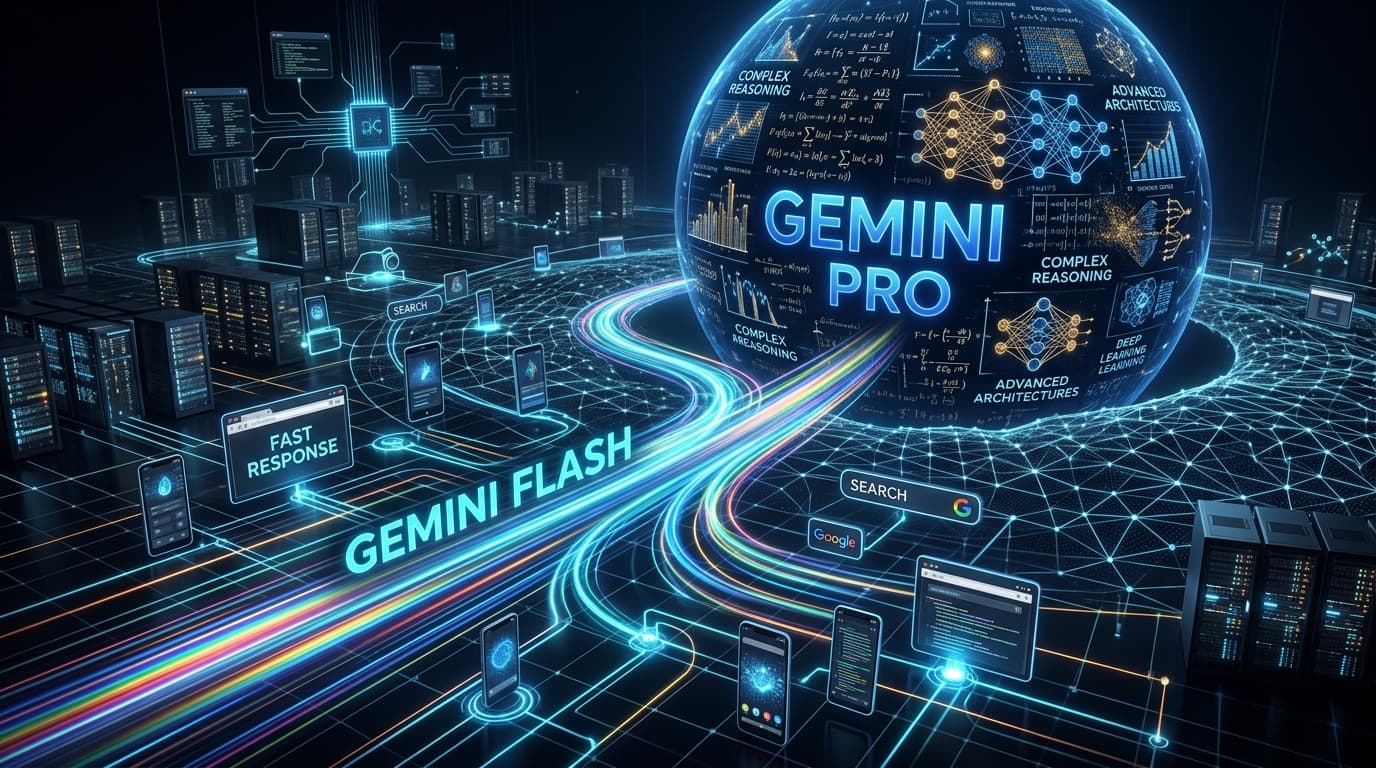
Over the past several months in 2026, Google’s release cadence for its Gemini model lineup began to look unusual.
While OpenAI and Anthropic staged headline-grabbing battles at the ultra-expensive frontier with models like GPT-6 Astra and Claude Fable 5.1, Google did something very different: it unleashed an avalanche of Gemini Flash models.
In the time that Google’s flagship reasoning model has remained parked on Gemini 3.1 Pro Preview, the company has shipped five consecutive iterations of its lightweight tier—rolling through Gemini 3.1 Flash-Lite, Gemini 3.5 Flash, 3.6 Flash, 3.7 Flash, and 3.8 Flash. Developers auditing their API dashboards noticed a strange discrepancy: Flash version numbers were climbing rapidly, while Google Gemini Pro appeared to have gone quiet.
This has triggered urgent questions across developer communities, enterprise engineering teams, and tech forums: Why doesn't Google release a new Gemini Pro model? Is Google abandoning Gemini Pro? Where does a flagship reasoning tier fit into Google's roadmap?
The answer isn't that Google has stalled. Instead, Google has executed a calculated pivot: the artificial intelligence market is shifting from "maximum theoretical intelligence per query" toward "maximum useful intelligence per dollar."
Google doesn't necessarily need a new Gemini Pro model to win a benchmark slide. It needs a model that is fast enough, cheap enough, and competent enough to run everywhere for billions of users.
Why Does Google Keep Releasing Gemini Flash Models?
To understand why Google keeps releasing Gemini Flash models at a breakneck pace, you have to look at the cold economics of large language model serving.
Frontier models like GPT-6 Astra or Claude Opus 5 require massive compute clusters, high-bandwidth memory, and multi-second deliberation loops. Every single token emitted costs real money in server power and water cooling. For an enterprise paying $15 to $50 per million output tokens, running autonomous agents or processing hundreds of thousands of customer interactions creates substantial operational expenses.
Google realized earlier than its competitors that 85% to 90% of real-world production workloads do not require doctoral-level theoretical reasoning. They require:
- Fast JSON extraction and strict schema validation.
- Real-time customer support chat with minimal latency.
- High-volume document summarization across millions of records.
- Inline code autocompletion and basic syntax linting.
- High-frequency agentic tool calling in automated background pipelines.
By iterating relentlessly on Flash—improving distillation techniques, integrating Per-Layer Embeddings, and tuning speculative decoding—Google brought Gemini 3.7 and 3.8 Flash to a point where they score within striking distance of older flagship models on benchmarks like SWE-bench and GPQA Diamond, while costing a tiny fraction of the price.
Flash is the model that generates real-world API volume and recurring cloud revenue.
Gemini Pro vs. Gemini Flash: What's Actually Different?
When deciding between Gemini Pro vs Gemini Flash, developers often make the mistake of looking strictly at top-line benchmark graphs.
In production, these two models fail in completely different ways, serve distinct latency profiles, and address divergent architectural needs.
| Architectural Dimension | Google Gemini Pro (Current: 3.1 Pro Preview) | Google Gemini Flash (Current: 3.7 / 3.8 Flash) | Production Verdict |
|---|---|---|---|
| Intelligence & Deep Logic | Superior Abstract Deduction. Resolves nuanced edge cases, multi-step formal logic, and complex system trade-offs without hallucinating. | High Surface Intelligence. Excellent at standard instructions; susceptible to logic drift on ambiguous, unstated requirements. | Pro for deep reasoning; Flash for structured execution. |
| Coding & Refactoring | Multi-File Root Cause Analysis. Identifies upstream race conditions and architectural bugs across deep dependency trees. | Rapid Implementation. Writes functional endpoints, React components, and test boilerplate instantly (65.3% DeepSWE v1.1). | Pro for deep debugging & architecture; Flash for fast code generation. |
| Latency & TTFT | Deliberate & Measured. Noticeable time-to-first-token (TTFT) pause; slower token streaming cadence. | Ultra-Low Latency. Streams at 100+ tokens per second with sub-200ms TTFT; feels instantaneous. | Flash wins decisively on interactive speed and responsiveness. |
| Context & Retrieval Fidelity | 1M – 2M Tokens. High attention density; preserves subtle multi-hop relationships across large codebases. | 1M Tokens. Strong single-needle recall (97% on GDM-MRCR v2), but displays slight attention dilution on deep synthesis. | Pro for multi-document synthesis; Flash for single-pass ingestion. |
| Pricing per 1M Tokens | ~$2.00 Input / $12.00 Output (Scales to $4/$18 above 200K tokens). | ~$0.75 Input / $3.75 Output (Flash-Lite drops to pennies: $0.15/$0.60). | Flash is roughly 3x to 10x cheaper across standard API calls. |
| Agentic Workloads | Strategic Orchestration. Acts as an executive planner, verifying subagent outputs and setting architectural bounds. | High-Frequency Worker. Executes bash commands, parses terminal logs, and calls tools in rapid loops. | Pro as the agent planner; Flash as the tool runner. |
| Availability | Gated preview in AI Studio & Vertex AI; throttled rate limits. | Universally available; default engine for free Gemini chat, AI Studio, and mobile. | Flash has universal distribution. |
The trade-off is clear: Flash gives you an answer immediately. But if that answer misses an unstated requirement or introduces a subtle bug, you spend 45 minutes fixing it. Pro takes longer and costs more per call, but it catches systemic flaws upfront.
Is Google Abandoning Gemini Pro?
The short answer is no. There is no credible evidence that Google is sunsetting the Pro tier.
However, Google is quietly doing something far more disruptive: it is fundamentally redefining what "Pro" is supposed to mean.
When the Gemini family launched, "Pro" was marketed as the default, balanced tier for everyday tasks, while "Ultra" was reserved for maximum frontier capability and "Nano" lived on devices.
That hierarchy has been overhauled:
- Flash became the new Pro: Gemini Flash took over the role of the default, daily-driver engine for consumers, developers, and enterprise applications.
- Pro moved into the Ultra vacuum: Because the original Gemini Ultra tier was too expensive and heavy to serve at scale, Google effectively folded Ultra-level research into Gemini Pro and its Deep Think extensions.
Google hasn't rushed out a "Gemini 3.5 Pro" or "Gemini 3.7 Pro" because training and aligning a massive, non-distilled foundation model requires immense capital, weeks of reinforcement learning, and rigorous safety evaluations.
Instead of shipping marginal 2% improvements on an expensive Pro architecture every two months, Google lets the flagship model cook until it represents a generational leap—using the interim months to harvest distillation efficiencies and push Flash to its absolute physical limits.
Why Flash Makes More Sense for Google's AI Strategy
OpenAI and Anthropic operate primarily as frontier software labs. They monetize by selling API tokens to developers and premium subscriptions to power users.
Google is an entirely different beast. Google is a global distribution utility operating consumer services that touch billions of active users every single day:
If Google were to power Google Search AI Overviews or Gmail Smart Replies using an expensive, slow reasoning model like Gemini Pro, their data center energy consumption and inference capital expenditure would skyrocket, crushing corporate operating margins.
To embed Gemini as the invisible operating layer of Android, Chrome, and Search, Google requires an inference engine that satisfies three non-negotiable criteria:
- Sub-second latency: A user waiting for a Search result will bounce if the page pauses for three seconds.
- Sub-cent cost: When serving billions of daily queries, a fraction of a cent per request compounds into billions of dollars.
- Multimodal flexibility: It must ingest camera frames, audio streams, text, and code simultaneously without requiring separate specialized models.
Gemini Flash is not an afterthought or a budget compromise—it is the exact engine Google’s multi-billion-user ecosystem was built to consume.
But Does Google Still Need a Flagship Gemini Pro?
Despite the commercial dominance of Flash, Google faces a clear risk if it neglects the high end of the intelligence spectrum: developer mindshare and frontier credibility.
When senior software engineers, scientific researchers, and enterprise architects evaluate which platform to build on, they do not start by asking which model is the cheapest. They ask: Which model is the smartest?
When OpenAI dropped GPT-6 Astra with breakthrough mathematics and autonomous computer use, and Anthropic released Claude Fable 5.1 with class-leading coding agent scores, developers paid attention.
If Google only offers fast, lightweight models:
- Complex Multi-File Refactoring: Autonomous coding agents (like Claude Code or Codex) will avoid Google’s ecosystem because Flash models still suffer from subtle context drift on long-horizon, 50-turn repository refactors.
- Formal Science and Mathematics: Frontier researchers working in genomics, molecular design, and theoretical mathematics need deep, unconstrained search capabilities that small distilled models cannot replicate.
- The "Halo Effect": If developers perceive Google as the provider of "good-enough budget models" while OpenAI and Anthropic own "frontier intelligence," top-tier enterprise contracts will naturally migrate toward competitors.
Google still needs a flagship Gemini Pro. Speed and cost efficiency win the mass market, but raw reasoning capability wins the architecture wars.
What Could a Future Gemini Pro Look Like?
When Google does pull the curtain back on the next generation of Google Gemini Pro (Gemini 3.5 Pro or Gemini 4 Pro), what should we expect?
Based on research directions out of Google DeepMind, the next flagship Pro release will likely diverge sharply from standard chat models:
1. Dynamic Test-Time Compute (Native Deep Think)
Rather than just emitting tokens through a standard single forward pass, the next Pro model will likely feature natively integrated reasoning effort controls (similar to Gemini 3.1 Deep Think). It will dynamically allocate compute—spending seconds planning, generating hypothesis trees, and self-correcting code in an isolated sandbox before returning an answer.
2. Autonomous Multi-Agent Orchestration
Instead of acting as a standalone conversationalist, a new Gemini Pro will likely be engineered as a Central Task Orchestrator. When given a complex assignment, Pro will write the high-level technical specifications and delegate parallel sub-tasks (scraping documentation, running linter tests, checking database schemas) to fleets of Gemini Flash workers.
3. Deeper Multimodal Spatial Reasoning
Building on the foundation of Project Astra, a next-gen Pro model will move beyond static image analysis into real-time 3D spatial grounding, understanding physical layouts, video streams, and complex mechanical diagrams with engineering precision.
The Developer Playbook: How to Route Between Flash and Pro Today
If you are building production applications on Google Cloud or Google AI Studio today, you should not choose between Flash and Pro as an either/or proposition. Modern system design relies on dynamic model routing.
-
Default to Gemini 3.7 / 3.8 Flash for All Incoming Calls: Baseline Execution. Route 100% of standard application queries—such as text extraction, initial user chat, classification, and standard function generation—to Gemini Flash. Configure the thinking level to
lowormediumto balance latency and quality. -
Implement an Evaluator-Critic Gateway: Complexity Evaluation. Construct a lightweight middleware check. If a user query involves multi-step code refactoring, ambiguous system architecture, or formal logic that fails a basic verification assertion, flag the request for escalation.
-
Escalate Blocked Tasks to Gemini 3.1 Pro: Targeted Escalation. Dispatch complex, high-stakes tasks to Gemini Pro. Pass the structured context and previous failed attempts, allowing Pro's deeper reasoning capacity to resolve the root cause without paying Pro rates on simple queries.
-
Use Pro to Plan and Flash to Execute: Subagent Delegation. In autonomous agent loops, direct Gemini Pro to generate the high-level execution plan (
PLAN.md) and define the API schemas. Then, deploy parallel Gemini Flash instances to execute the individual file edits, tests, and bash commands.
The Big Picture: Scale Beats Vanity
The question "Why doesn't Google release a new Gemini Pro model?" is built on an outdated assumption: that winning in artificial intelligence is solely about holding the #1 spot on an academic benchmark leaderboard for forty-eight hours.
Google understood that benchmark trophies don't pay for data centers. Scale, latency, and unit economics do.
By flooding the zone with Gemini Flash models, Google turned state-of-the-art multimodal AI into a ubiquitous, sub-cent utility that runs natively inside Search, Android, Chrome, and Cloud.
Google didn't forget about Gemini Pro. They are simply ensuring that when the next flagship reasoning model finally arrives, it lands on an infrastructure grid capable of serving it to billions of people without breaking a sweat. In the war for AI dominance, intelligence is the weapon—but scale is the battlefield.