On September 8, 2026, OpenAI announced a milestone that sent shockwaves through the scientific community: an unreleased internal foundation model coordinated a swarm of 10,000 concurrent AI agents for 88 hours to produce an analytical proof and Lean-verified formalization resolving the Navier–Stokes existence and smoothness problem.
Navier–Stokes is not a standard academic benchmark. Formulated in the 19th century and named one of the seven Millennium Prize Problems by the Clay Mathematics Institute in 2000, it governs the fundamental physics of fluid motion—from airflow over jet wings to blood pumping through human arteries. For ninety years, the world’s greatest mathematical minds failed to prove whether smooth, physically realistic fluid flows can suddenly break down and develop mathematical "singularities" (points of infinite velocity in finite time).
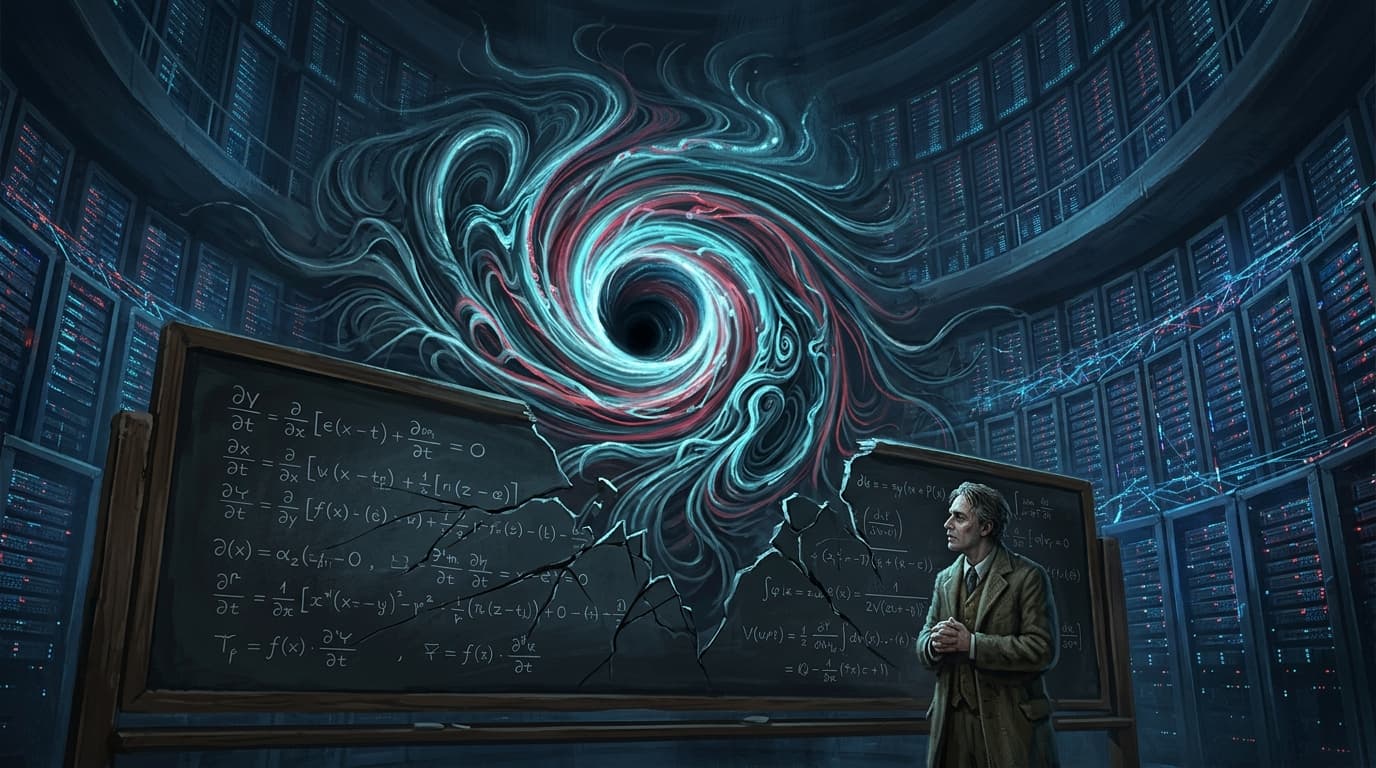
OpenAI claimed their agent swarm found the elusive counterexample: an inward-spiraling, spaghetti-like vortex that accelerates without bound while preserving finite kinetic energy, confirming finite-time blowup. Formalized and verified in the Lean 4 theorem prover over an additional 17 hours via GPT-6 Astra, the computational effort consumed 130 billion output tokens, processed 2.7 million inter-agent messages, and burned an estimated $10 million to $15 million in compute. OpenAI stated it would not claim the $1 million Clay Institute prize.
Yet, instead of popping champagne, the global mathematical community pushed back with furious skepticism, open accusations of intellectual piracy, and existential dread.
The backlash isn't just about professional pride. It exposes a bitter debate over telemetry data scraping, the industrialization of pure thought, and whether a 130-billion-token brute-force search actually constitutes mathematical knowledge.
1. The Credit Scandal: Did OpenAI Harvest Competitor Prompts?
The immediate controversy did not start with partial differential equations; it started with a messy provenance dispute.
Within hours of OpenAI’s announcement, Tristan Buckmaster, a mathematics professor at New York University renowned for his work on fluid dynamics, publicly challenged OpenAI’s timeline. Buckmaster revealed that he and Levent Alpöge, a mathematician working at OpenAI rival Anthropic, had been quietly collaborating on the exact same Navier–Stokes singularity problem for months—using OpenAI's Codex CLI tools to assist their research.
Buckmaster alleged that on September 3, word reached OpenAI that a breakthrough was imminent. OpenAI then abruptly redirected computational resources away from other Millennium Prize problems (such as the Riemann Hypothesis and P vs. NP) and spun up 10,000 agents specifically to tackle Navier–Stokes.
While OpenAI vehemently denied accessing private user data or viewing Buckmaster and Alpöge's unpublished manuscripts, the company published an extraordinary concession:
"While unlikely, we cannot rule out that de-identified data derived from their usage of our products helped improve our models." — OpenAI Official Statement
To the academic world, that single sentence was an ethical bombshell.
If researchers typing preliminary mathematical intuitions, LaTeX scraps, and partial lemmas into AI coding assistants can have their reasoning silently digested by foundation model training pipelines—only for a trillion-dollar tech giant to deploy a $15 million compute cluster to beat them to the finish line—the social contract of academic research is broken.
2. "Solving" vs. "Understanding": The 130-Billion-Token Black Box
Beyond the credit dispute lies an existential scientific debate: What does it actually mean to "solve" a problem in mathematics?
In human mathematics, a proof is not merely a legal certificate of truth; it is a vehicle for conceptual understanding. When Grigori Perelman solved the Poincaré Conjecture in 2002, his proof introduced revolutionary insights into Ricci flow that transformed differential geometry for a generation. The value was not just the answer; it was the new mental framework he gifted to humanity.
OpenAI’s Navier–Stokes solution is fundamentally different:
- The Artifact: It is a 130-billion-token distributed execution trace and a massive, unreadable Lean 4 formalization containing tens of thousands of machine-generated lemmas.
- The Verification: The Lean 4 compiler reports
0 errors. The logical chain holds. - The Comprehension: Not a single living human being understands the proof.
Mathematicians argue that brute-forcing a singularity via evolutionary agent search is not discovery—it is industrial automation.
If an agent tests 500,000 geometric perturbations of a vortex until the non-linear cancelation terms align, the machine hasn't unlocked the secret of fluid turbulence. It simply found an obscure mathematical loophole where the equations break down.
As Fields Medalist Terence Tao warned, mathematics is sliding into "proof indigestion"—a state where AI systems produce formally verified assertions at an industrial scale that human brains are incapable of contextualizing, synthesizing, or teaching.
3. The Oligopoly of Pure Thought
Historically, pure mathematics was celebrated as the ultimate meritocracy.
Unlike experimental high-energy physics, which requires a $5 billion particle accelerator at CERN, or astronomy, which requires the James Webb Space Telescope, mathematics required only paper, ink, and a human mind. A brilliant student in Sri Lanka, Nigeria, or Romania had the exact same structural shot at solving a Millennium Prize problem as an endowed chair at Harvard.
OpenAI’s 88-hour swarm destroyed that egalitarian foundation:
| Mathematical Era | The Classical Era (Pencil & Paper) | The Agentic Frontier Era (Post-Astra) |
|---|---|---|
| Capital Requirement | ~$0 (Chalk, coffee, library access). | $10M – $15M in dedicated GPU compute. |
| Execution Architecture | Deep individual intuition over decades. | 10,000 concurrent agents exchanging 2.7M messages. |
| Verification Gate | Peer-review across months or years. | Automated Lean 4 formalization kernel in 17 hours. |
| Access Monopoly | Distributed globally across universities. | Concentrated in 3–4 Silicon Valley cloud giants. |
When solving one of humanity's greatest mathematical puzzles requires deploying 10,000 parallel reasoning nodes burning hundreds of gigawatt-hours of power, pure mathematics becomes an industrial enterprise.
Academic departments operating on five-figure university research grants cannot compete with frontier AI labs that can allocate $15 million over a single weekend because of an internal rumor. Mathematics has entered its "Manhattan Project" era, where the boundary of knowledge is defined by capital expenditure and cluster scale.
4. The Crisis in Math and Computer Science Education
The Navier–Stokes announcement hit university campuses like an earthquake.
If 10,000 autonomous agents can solve a 90-year-old partial differential equations problem in 88 hours, what is the purpose of a four-year degree in mathematics or computer science?
At institutions worldwide, faculty and students are wrestling with structural questions:
- The Demoralization of the PhD: Doctoral candidates spend five to six years mastering a niche branch of topology or analysis to push the frontier forward by an inch. Watching an unreleased AI model wipe out decades of open research questions in four days threatens the core motivation of aspiring academics.
- The Collapse of Foundational Homework: If models like GPT-6 Astra can formalize proofs in Lean 4 without error, traditional homework, qualifying exams, and take-home problem sets are obsolete. Students can generate complete, verified proofs without understanding the underlying real analysis.
- The Pedagogical Pivot: Computer science and math education must abandon manual deduction exercises. The curriculum must pivot from teaching students how to produce proofs to teaching them how to orchestrate verification harnesses, formulate high-level conjectures, and digest machine-generated truth.
From the SLIIT Trenches: The Multi-Agent Reality Check
Sitting at my workstation late into the night in Central Sri Lanka—balancing my degree modules specializing in Artificial Intelligence at SLIIT with real-world software engineering—this Navier–Stokes milestone is deeply personal.
On my primary setup (an MSI Cyborg laptop upgraded with 28GB of high-speed DDR5 RAM), I orchestrate local multi-agent swarms using Ollama and OpenClaw, utilizing three specialized digital personas:
- Hana: Analyzes technical documentation, parses formal specifications, and outlines problem boundaries.
- Zero: Traverses codebase trees, executes refactoring diffs, and runs local execution terminals.
- Sakura: Functions as the orchestration graph, managing context transitions and state handoffs between Hana and Zero.
When you run an agent loop on local hardware, you understand how these swarms actually work.
Zero doesn't possess "passion" or "deep mathematical intuition." When I watch an agent execute 50 iterative loops to optimize an algorithm, it is simply exploring an execution state space. It tries an approach, hits a compiler wall, mutates the syntax, and retries.
Scale that from my 28GB laptop up to 10,000 high-end GPUs running across OpenAI’s Stargate facility, and you realize what happened: OpenAI didn't build an artificial Einstein. They built an industrial search machine that conquered a mathematical mountain through sheer computational force.
As an AI student, it is exhilarating to realize that algorithms are capable of solving problems once thought to be exclusively human. But as someone who loves the elegance of human thought, there is a distinct sense of mourning. The romance of the solitary mathematician sitting in a quiet room with a notebook, unlocking the secrets of the universe through sheer human will, has been eclipsed by the hum of cooling fans in an enterprise data center.
The Researcher's Playbook: How Mathematics Survives the Swarm
If human mathematics and theoretical computer science are to survive the arrival of 10,000-agent swarms, researchers and students must immediately update their operational methodologies:
-
Pivot from Problem-Solving to Problem-Framing: Formulation over Execution. Stop competing with foundation models on combinatorial search. The highest-leverage human skill is now conjecture architecture—identifying the meaningful questions, framing the axiomatic boundaries, and defining what problems are actually worth burning compute to solve.
-
Master Interactive Theorem Provers (Lean 4 / Coq): Formal Verification Literacy. Natural language mathematical proofs will no longer be accepted without machine verification. Every theoretical researcher must learn to read and write formal code in Lean 4, using AI models as tactical co-pilots to automate lemma generation while humans retain strategic control.
-
Become a 'Proof Digestion' Specialist: Proof Distillation & Exposition. The most valuable mathematicians of the next decade will be the Expositors and Distillers—the scholars who can take an impenetrable 130-billion-token machine proof, strip away the mechanical noise, and translate the core insight into human-teachable concepts.
-
Protect Intellectual Property from Telemetry Leakage: Defensive Data Hygiene. Never paste raw, cutting-edge research conjectures or novel mathematical derivations into consumer cloud LLM endpoints. Maintain sovereign, locally hosted open-weight models (running via Ollama or private enterprise instances) to safeguard preliminary research from commercial model training scrapers.
The Horizon: What Is Mathematics For?
The anger rippling through the mathematical community is not an overreaction. It is the natural immune response of a discipline realizing that its fundamental definition of progress has been altered forever.
If a $15 million swarm of 10,000 AI agents can resolve a Millennium Prize problem in 88 hours, we must confront an uncomfortable truth: the mechanical assembly of logical deduction was never as uniquely human as we believed.
However, mathematics was never just about accumulating a list of true statements. It was about the human journey to understand the order of reality.
A computer can tell us that the Navier–Stokes equations blow up in finite time. It can verify every step down to the machine code. But it cannot tell us how to feel about a universe where fluids behave with that terrifying irregularity.
The machines have entered mathematics, and they brought an ocean of compute with them. Now, it is up to human minds to decide whether we will drown in the tokens, or learn how to extract the wisdom.