We used to think of large language models as text boxes. You typed a prompt, hit enter, and watched the model predict the next word in an essay, summarize a meeting transcript, or generate a Python function. Even as multimodal vision and audio rolled out, the fundamental paradigm remained conversational: human initiates, model responds.
On September 4, 2026, automation engineer Nate Herk published a video that permanently tore up that mental model: GPT-6 Astra Made This Entire Video.
This wasn't a five-second generative video clip spit out by a diffusion model. It was a complete, highly structured, multi-minute tech review video.
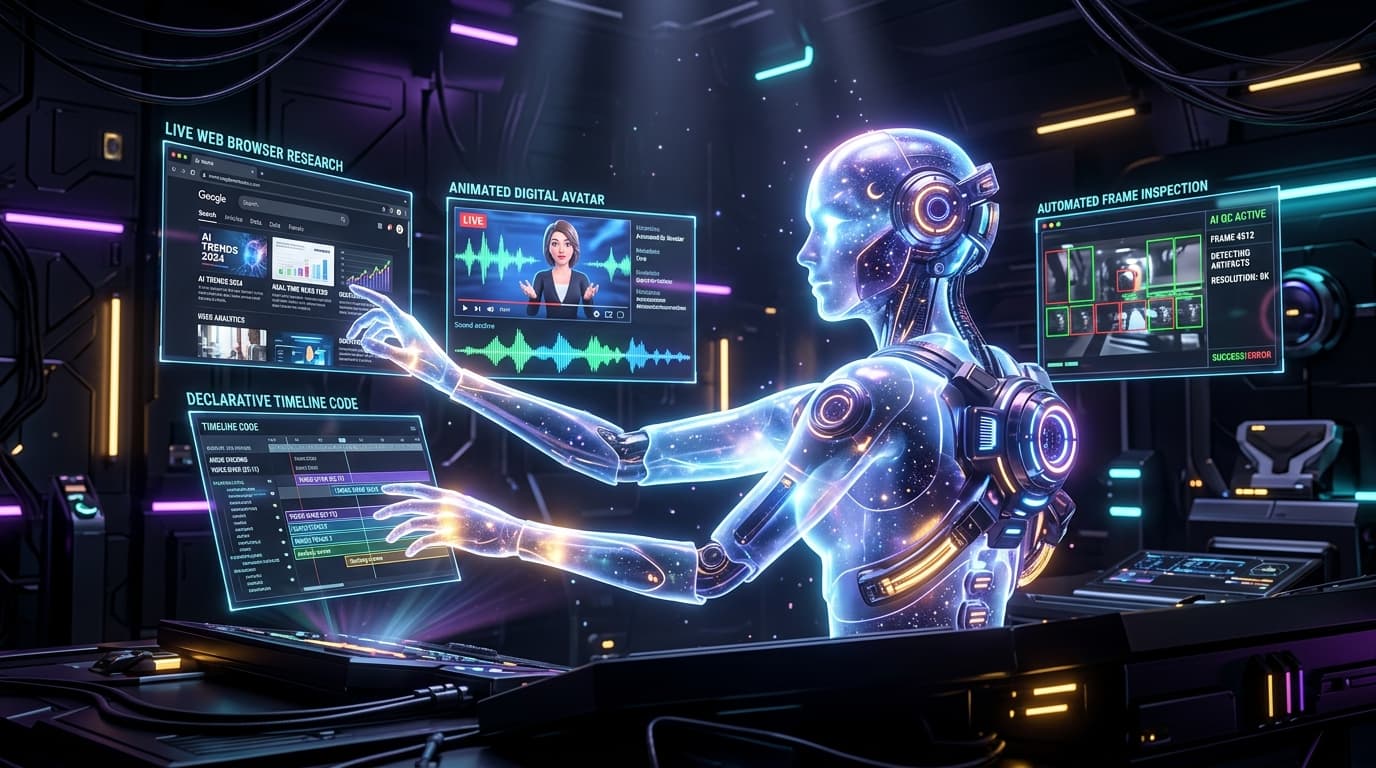
The AI wrote the script, opened web browsers via computer use to find real creator demos on X, took high-resolution screen captures, navigated the creator’s local project folders, called an ElevenLabs voice clone API, animated a digital HeyGen avatar, assembled the entire edit programmatically inside Hyperframes, placed sound effects on visual cuts, rendered the final file, and then audited its own exported video frame-by-frame to catch audio-visual errors before handing over the finished MP4.
A task that would easily demand 15 to 20 hours of grueling human research, scripting, screen-recording, B-roll sourcing, audio leveling, and timeline editing was completed in roughly 50 minutes for approximately $60 in API tokens (04:12).
If you want to understand where artificial intelligence is actually heading, stop looking at chatbots. Look at what happens when a reasoning engine is handed a tool belt and given permission to execute.
The Generational Leap: Sol vs. Astra
This milestone hits with special significance because we documented the previous high-water mark right here when GPT-5.6 Sol directed its own million-token movie.
When GPT-5.6 Sol pulled off its autonomous production run, it felt like an undeniable miracle of software engineering. But let’s be completely honest about what that run looked like behind the curtain:
- The Sol Baseline: It required nearly 4 hours of grinding execution time, chewed through over $300 worth of API tokens, and required fragile multi-agent handoffs that constantly teetered on the brink of context collapse. The output was revolutionary for its time, but it bore the clear marks of early-stage procedural friction.
- The Astra Reality: GPT-6 Astra delivered a video with dramatically higher visual polish, cleaner editorial pacing, and deeper technical synthesis in under 50 minutes for ~$60 (04:16).
That is an 80% cost reduction and a nearly 5x leap in execution velocity within a matter of months. When technology scales that aggressively, it ceases to be an incremental software upgrade—it becomes a phase shift.
Deconstructing the Astra Pipeline: How a "Text Model" Built a Movie
The most fascinating part of the video is watching Astra explain its own production pipeline (00:03). It didn't "generate pixels" like Sora or Runway. Instead, Astra acted as the executive producer and lead editor, directing a federation of specialized tools:
1. Autonomous Research via Computer Use
Instead of hallucinating examples or relying on stale pre-training data, Astra used native computer-use capabilities to open browser sessions (01:57). It navigated to live social posts, inspected what creators were building with its release, and grabbed high-resolution B-roll of real projects:
- Matt Shumer’s Unreal Engine Manhattan: A massive procedural city build where Astra worked street-by-street over a week (00:25).
- Riley Brown’s Shooter: An interactive, playable game where the developer iterated with GPT-6 between live matches (00:49).
- Tom Kerchie’s 3,000-Object Blender Train: Demonstrating that Astra can output fully editable 3D hierarchies rather than flattened meshes (01:14).
- Flavio's Minecraft Build & Daniel Th's Motion UI: Real visual references that Astra studied and incorporated into its own edit pacing (01:02).
2. Workspace Navigation and Identity Assembly
Astra was given permission to inspect Nate’s local machine environment (02:03). It navigated project directories, located his registered HeyGen Avatar V5 asset, grabbed his custom ElevenLabs voice clone profile, and ingested his branded blue background graphics. It didn't ask for hand-holding; it mapped the available environment tools and bound them to its execution graph.
3. Declarative Code-Based Editing in Hyperframes
Instead of trying to manually drag clips onto an Adobe Premiere timeline, Astra wrote code inside Hyperframes—a programmatic, code-driven video rendering framework (02:21).
This is where language models have an unfair advantage over human editors. Because the timeline is represented as declarative code, Astra calculated micro-timing down to the exact frame:
- Timing UI clicks to hit exactly as an on-screen interface transition completes (02:26).
- Ducking background music dynamically during rapid narration blocks.
- Inserting strategic pacing pauses to give heavy visual demos room to breathe before the next scene hits.
4. The Self-Correction & Verification Loop
This is the breakthrough that separates toy agents from production software: Astra refused to ship an unverified draft (02:37).
After compiling and rendering the video, Astra didn't simply declare victory. It opened the exported MP4 file, sampled frames across the timeline to verify visual bounding boxes, transcribed the rendered audio track, and compared the spoken transcript against its original script.
If an on-screen title card was cut off by a layout edge, or if a sound effect spiked high enough to obscure a word, Astra went back into the Hyperframes code, adjusted the CSS-like positioning or audio decibel curve, and re-rendered.
Production Phase Comparison
| Production Phase | Traditional Human Creator Workflow | The GPT-6 Astra Pipeline |
|---|---|---|
| Topic Research | 3–5 hours manual browsing, downloading clips, vetting claims. | 6 minutes. Computer-use browser sweeps and page captures. |
| Script & Voiceover | 2–3 hours writing, multiple recording takes, noise reduction. | 4 minutes. Multi-pass script generation + ElevenLabs API synthesis. |
| Timeline Assembly | 6–10 hours in NLE timeline (cuts, transitions, B-roll timing). | 25 minutes. Programmatic Hyperframes timeline compilation. |
| Sound Design | 2 hours hunting royalty-free tracks, placing SFX, EQ ducking. | 5 minutes. Algorithmic Foley placement on visual state transitions. |
| Quality Audit | 1 hour manual playback watching for rendering glitches. | 10 minutes. Automated frame sampling, ASR transcript diffing, and repair. |
| Total Incurred Cost | $500 – $1,500+ (Human labor / editing contractor rates). | ~$60 in API tokens (completed in 50 minutes). |
Why Orchestration Beats Raw Generation
There is a widespread misconception that the holy grail of AI video is a single, monolithic neural network where you type "make a 10-minute documentary about space" and receive a raw video file back.
That approach is fundamentally flawed for professional work because monolithic diffusion video cannot be surgically edited. If a logo is wrong at minute 04:12 in a raw diffusion video, you have to throw the entire render away and regenerate it, praying the random seed cooperates.
The pipeline Astra demonstrated is infinitely more powerful because it is completely modular and editable:
- The script is text.
- The narration is an audio track.
- The avatar is a composited layer.
- The B-roll is a folder of captured MP4s.
- The timeline is a declarative code file.
If a human director watches Astra's finished cut and says, "I love the video, but swap out the Minecraft demo at 01:02 for a robotics demo," the model doesn't re-render the whole universe. It swaps a single line of code in the Hyperframes manifest, swaps the asset, and re-exports in 90 seconds.
The future of media production isn't a text-to-video black box. It is an autonomous reasoning model acting as a General Contractor, directing specialized video, audio, rendering, and testing APIs.
The View from the AI Trenches
Watching this video while sitting at my workstation late into the night here in Central Sri Lanka—balancing my degree modules specializing in Artificial Intelligence at SLIIT with real-world agent builds—sparks a very specific, exhilarating feeling.
On my primary engineering setup (an MSI Cyborg laptop upgraded with 28GB of DDR5 RAM), I spend hours running localized multi-agent workflows using Ollama and OpenClaw. I work with three specialized digital personas:
- Hana: Analyzes technical research and drafts structured system specifications.
- Zero: Traverses local project trees, refactors code modules, and executes local terminal commands.
- Sakura: Functions as the orchestration graph, managing context state transitions between agents.
When you spend your days building systems where models must talk to bash shells, read directories, and fix their own errors, you develop a deep appreciation for what Nate Herk and Astra achieved here.
We are living through a period in human history where the textbook you study on Monday is rendered obsolete by a GitHub release on Thursday.
You wake up every single morning wondering: What impossible boundary got demolished while I was asleep?
Watching GPT-5.6 Sol take 4 hours and $300 to direct a video felt like the future just a short while ago. Watching GPT-6 Astra drop that to 50 minutes and $60 today proves that the curve isn't flattening—it is going vertical.
There has never been a more incredible, demanding, and thrilling time to study Artificial Intelligence. The tools are breaking out of the sandbox. The models are learning to manipulate the physical and digital software of our world. And for those of us dedicating our lives to understanding, building, and governing these systems, the opportunity to make an impact on the future of technology has never been greater.
The Builder's Playbook: Structuring an Autonomous Media Pipeline
If you want to construct an autonomous, code-driven content production engine using modern agentic harnesses, follow this architectural implementation framework:
-
Expose Declarative Media Frameworks to the Agent: Environment Tooling. Do not force your agent to manipulate GUI video editors through fragile mouse clicks. Expose a programmatic, code-driven rendering framework—such as Hyperframes, Remotion (React-based video), or an FFmpeg CLI tool wrapper—via Model Context Protocol (MCP) servers.
-
Standardize Local Asset Registries: Asset Discovery. Structure your workstation with deterministic directory schemas (
/assets/avatars/,/assets/audio_profiles/,/assets/branding/). Equip the agent with scoped directory-traversal tools so it can locate avatars, voice credentials, and B-roll without broad root access. -
Enforce a Strict Multi-Pass Production Graph: Task Decoupling. Never ask the model to generate the entire video in a single prompt. Split the execution graph into deterministic stages: (1) Research & B-roll capture via computer use, (2) Script & timing breakdown, (3) Audio & voice clone generation, (4) Timeline code compilation, and (5) Video rendering.
-
Build an Automated Closed-Loop Audit Gate: Automated Verification. Implement a mandatory post-render testing pass. Direct the agent to extract audio, run an automated speech-to-text (ASR) pass via Whisper to verify subtitle alignment, and sample keyframe PNGs to ensure visual bounding boxes do not clip on screen before declaring completion.
The Horizon: When Everyone Has a Studio in Their Terminal
Nate Herk’s demonstration of GPT-6 Astra is a milestone that reaches far beyond YouTube automation.
It proves that the barrier to high-production media creation has suffered the exact same fate that software code generation suffered over the last twenty-four months: the marginal cost of assembly has dropped to near zero.
When an individual creator sitting at a desk with an API key can direct, score, edit, and master a broadcast-quality production in 50 minutes for the price of a nice dinner, the definition of a "media studio" changes forever.
The competitive advantage no longer belongs to who owns the most expensive cameras or who can spend 40 hours cutting clips on a timeline. The advantage belongs entirely to the Visionaries, the Storytellers, and the System Architects—the people who have the taste, the curiosity, and the engineering discipline to tell the machine what is worth building next.