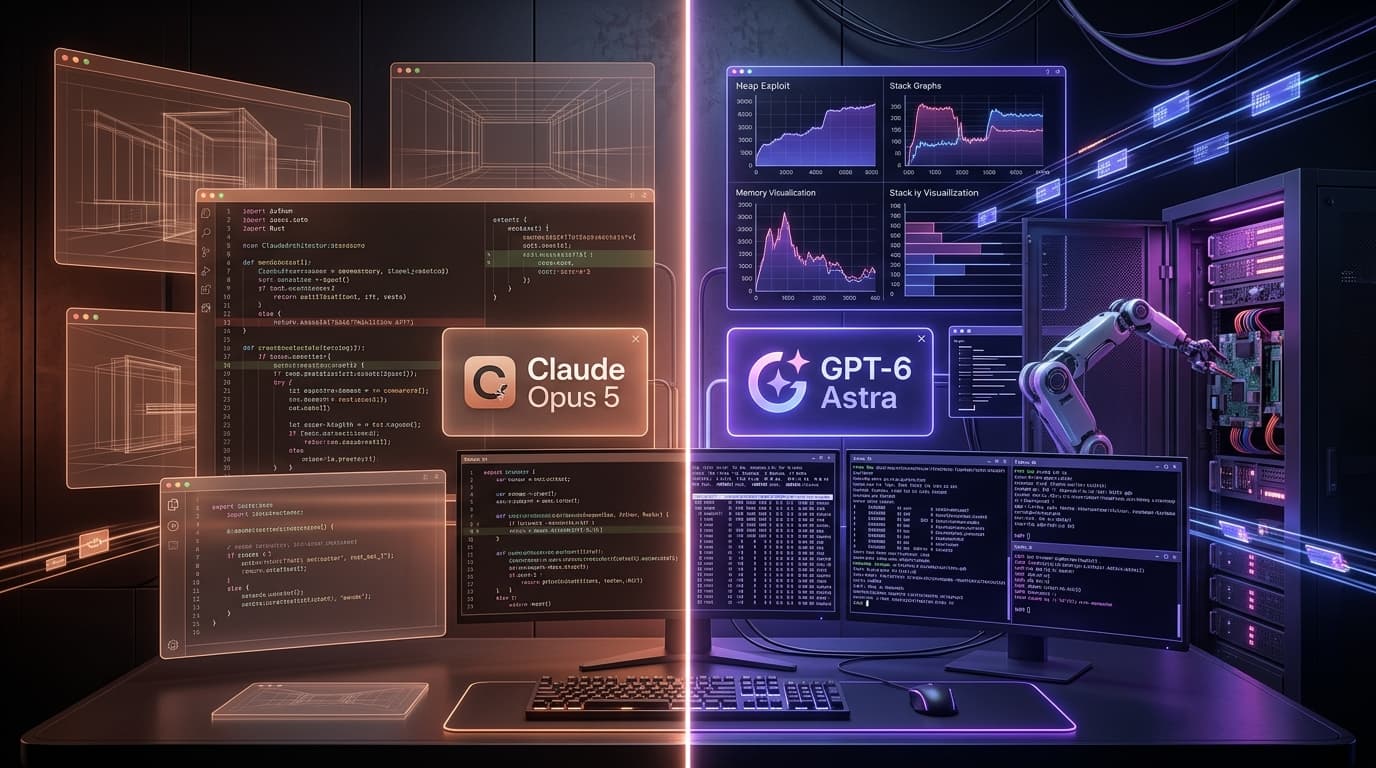
On paper and across synthetic benchmark slides, GPT-6 Astra claims parity or marginal leads in terminal execution and mathematical reasoning. But inside real-world production repositories, Claude Opus 5 remains the developer’s choice for software engineering judgment, architectural consistency, and clean, merge-ready pull requests.
The arrival of GPT-6 Astra sparked an immediate split in the developer community. Early discussions across Reddit, X, and internal engineering channels revealed a distinct divide: while benchmark enthusiasts celebrated Astra's headline scores, working software engineers using both models in IDE extensions and terminal harnesses repeatedly reported that Astra still lags behind Anthropic’s flagship in daily development ergonomics.
OpenAI built an extraordinary terminal operator and security researcher. But Anthropic built a Senior Software Architect.
The Benchmark Scorecard: What the Numbers Say
When you look past vendor-curated PR announcements and examine standardized, third-party evaluations from the Artificial Analysis Coding Agent Index, the gap between the two models is razor-thin:
| Evaluation Metric | GPT-6 Astra (in Codex) | Claude Opus 5 (in Claude Code) | Practical Engineering Verdict |
|---|---|---|---|
| Artificial Analysis Coding Agent Index | 67.0 | 68.1 (Claude Fable 5.1 leads at 70) | Opus 5 / Fable 5 hold the composite lead in agentic software engineering. |
| DeepSWE v1.1 (Multi-File Repo Tasks) | 74.1% | 73.7% | Statistical Tie. Astra solves 1.4% more raw issues, but requires tighter sandboxing. |
| Terminal-Bench 4.0 | 57.9% | 52.6% | Astra wins. Superior at low-level bash, tool-chain errors, and shell manipulation. |
| FrontierCode 1.1 Main | 53.3% | 53.4% | Dead heat across complex algorithmic generation. |
| OSWorld 2.0 (Agentic Computer Use) | 72.6% | 70.2% | Astra wins. Native visual grounding and GUI desktop navigation. |
| ExploitBench (Cybersecurity / CVEs) | 100.0% | 70.0% | Astra dominates. Unmatched offensive reasoning and memory exploit generation. |
| Token Efficiency per Task | ~1/3 Output Tokens of Sol | Standard Verbose Output | Astra wins on density. Plans internally to emit compact diffs. |
The numbers explain why developer sentiment is conflicted. Astra scores equal or slightly higher on tasks that involve driving bash commands, searching environments, and brute-forcing exploit paths. But software engineering is not just hacking shell scripts—it is primarily about maintaining living, complex codebases without breaking existing systems.
Why Developers Say Astra Still "Feels Worse"
The skepticism from practitioners on Reddit and developer forums stems from qualitative realities that synthetic benchmarks fail to capture:
1. Codebase "Taste" and Pattern Preservation
The defining superpower of Claude Opus 5 is architectural restraint. When you drop Opus 5 into an existing 50,000-line codebase, it inspects your local conventions:
- It adopts your exact error-handling signatures.
- It follows your functional or object-oriented patterns without injecting foreign paradigms.
- It modifies only the lines strictly necessary to resolve the issue.
GPT-6 Astra, despite its dense reasoning tokens, frequently displays what developers call "aggressive over-engineering." It tends to refactor adjacent functions that weren't broken, introduces unnecessary utility classes, or swaps out established project dependencies for alternatives it prefers. It solves the stated ticket, but leaves behind architectural churn that frustrates human code reviewers.
2. The "Would I Actually Merge This?" Metric
When reviewing a pull request generated by an autonomous agent, human engineers look for three things: zero hallucinations, no removed comments, and no incomplete logic stubs.
Opus 5 has an exceptionally high "first-turn acceptance rate". It catches its own logical faults during its internal planning phase rather than discovering them through runtime compiler crashes.
Astra will eventually reach a working solution through iterative tool calls, but the resulting diff often resembles code written by an outside contractor who didn't bother reading the rest of the repository.
3. Understanding Implicit Requirements
As software engineering benchmarks have matured, implicit requirements have emerged as the single largest point of agent failure.
When given a prompt like "Add an export button to the user table," Claude Opus 5 automatically infers that the CSV export needs pagination handling, date sanitization, and permission checks based on existing user roles.
Astra frequently implements the literal button and the naive export route, requiring the developer to prompt it two or three additional times to handle basic security and state boundaries that Opus 5 caught upfront.
Where GPT-6 Astra Genuinely Outclasses Opus 5
Writing off GPT-6 Astra based on developer taste alone ignores areas where OpenAI’s model genuinely leads the industry:
1. Terminal Tool Chains and Environment Repair
If a build system breaks due to obscure glibc incompatibilities, circular CMake dependencies, or corrupted lockfiles, Astra is unmatched. Scoring 57.9% on Terminal-Bench 4.0, Astra navigates Linux terminals, runs diagnostic probes, inspects system sockets, and patches low-level configuration files far more effectively than Opus 5.
2. Token Density and Internal Reasoning
Astra is exceptionally token-efficient. While Claude Opus 5 can be verbose—generating hundreds of lines of explanatory markdown and user-facing status commentary—Astra conducts its recurrent depth reasoning internally. It emits approximately 65% fewer output tokens on complex tasks, producing concise, dense solutions that save time in automated agentic harnesses.
3. Low-Level Silicon and Mathematical Algorithms
When the engineering challenge involves raw mathematical correctness—such as writing custom CUDA kernels, designing cryptographic state machines, or compiling CAD geometry—Astra’s dominance on benchmarks like FrontierMath Tier 4 (97.6% vs. 73.2%) translates directly into practice. Where Opus 5 can hallucinate complex tensor transformations, Astra evaluates the underlying math with formal precision.
Head-to-Head: Developer Ergonomics
| Feature / Workflow | Claude Opus 5 | GPT-6 Astra | Winner |
|---|---|---|---|
| Everyday IDE Autocomplete & Pairing | Smooth, idiomatic TypeScript/Python; respects repository context. | Terse, highly functional, but occasionally unidiomatic. | Claude Opus 5 |
| Multi-File Refactoring (Monorepos) | Retains pattern discipline across 50+ files without drift. | Excellent 1M context retrieval, but higher propensity for code sprawl. | Claude Opus 5 |
| DevOps, Docker & CI/CD Debugging | Good, but can stall when encountering obscure shell errors. | Relentless terminal investigator; fixes environment breakages fast. | GPT-6 Astra |
| Autonomous Computer Use & GUI | Solid OS navigation (70.2% OSWorld 2.0). | 72.6% OSWorld 2.0; superior desktop screen perception. | GPT-6 Astra |
| API Pricing per Task | High output verbosity drives up total token costs. | High base rate ($10/$50), but low output volume balances costs. | Tie |
From the SLIIT Trenches: The Multi-Agent Reality Check
Sitting at my workstation late into the night here in Central Sri Lanka—balancing Artificial Intelligence modules at SLIIT with real-world software builds—this architectural divide is an operational reality.
On my primary development setup—an MSI Cyborg laptop upgraded with 28GB of high-speed DDR5 RAM—I spend hours orchestrating autonomous agent workflows using Ollama, OpenClaw, and cloud APIs. My local development grid relies on three specialized digital personas:
- Hana (Research & Spec Architecture): Ingests technical documentation and structures system specifications.
- Zero (Execution & Code Refactoring): Traverses local project trees, refactors code modules, and executes local terminal commands.
- Sakura (Workflow Management): Functions as the orchestration graph, managing context state transitions and memory handoffs between Hana and Zero.
When I route a difficult refactoring task through Zero, the model choice determines the outcome:
- When I point Zero to Claude Opus 5, the resulting Git diff is clean, adheres strictly to my
.cursorrules, and passes our continuous integration pipeline on the first attempt. - When I point Zero to GPT-6 Astra, the agent runs faster and solves obscure package compilation errors independently, but I spend twice as long reviewing the pull request to ensure it didn't rewrite functional utility libraries.
Astra is the engineer you call when the server is down and the Docker container won't boot. Opus 5 is the architect you hire to build features that your team has to maintain for the next five years.
The Developer Playbook: How to Deploy Both Models
Instead of engaging in tribal brand loyalty, modern software engineering teams should route tasks dynamically between both foundation engines:
-
Use Claude Opus 5 for Initial RFCs and Domain Modeling: System Architecture. When architecting a new feature, database schema, or API interface, prompt Claude Opus 5. Its superior contextual restraint and understanding of system trade-offs ensure clean, idiomatic design patterns.
-
Dispatch GPT-6 Astra to Debug CI/CD and Container Breakages: Environment Triage. When pipelines fail due to dependency mismatches, broken native build bindings, or network configuration errors, hand the terminal shell directly to Astra. Its 57.9% Terminal-Bench capability makes it the most effective automated system administrator available.
-
Deploy Opus 5 for Feature Pull Requests: Code Generation. Route core application feature development through Opus 5 (or Claude Fable 5.1 in Claude Code). It writes clean diffs, respects existing linters, and leaves code that human teammates can review and merge with minimal cognitive friction.
-
Escalate Low-Level Algorithms to GPT-6 Astra: Performance & Math. For high-performance computing, complex vector math, custom WebGPU shaders, or automated vulnerability audits, route execution to Astra to capitalize on its 97.6% FrontierMath and 100% ExploitBench strengths.
The Verdict
If your definition of "coding" is discovering zero-day security vulnerabilities, automating complex terminal commands, and driving desktop operating systems autonomously, GPT-6 Astra is the most powerful tool ever built.
However, if your definition of coding is software engineering—writing maintainable code, respecting existing project conventions, inferring unstated business requirements, and shipping clean diffs that don't terrify your team lead—Claude Opus 5 is still the king of the codebase.
OpenAI closed the benchmark gap, but Anthropic still owns the craft.