
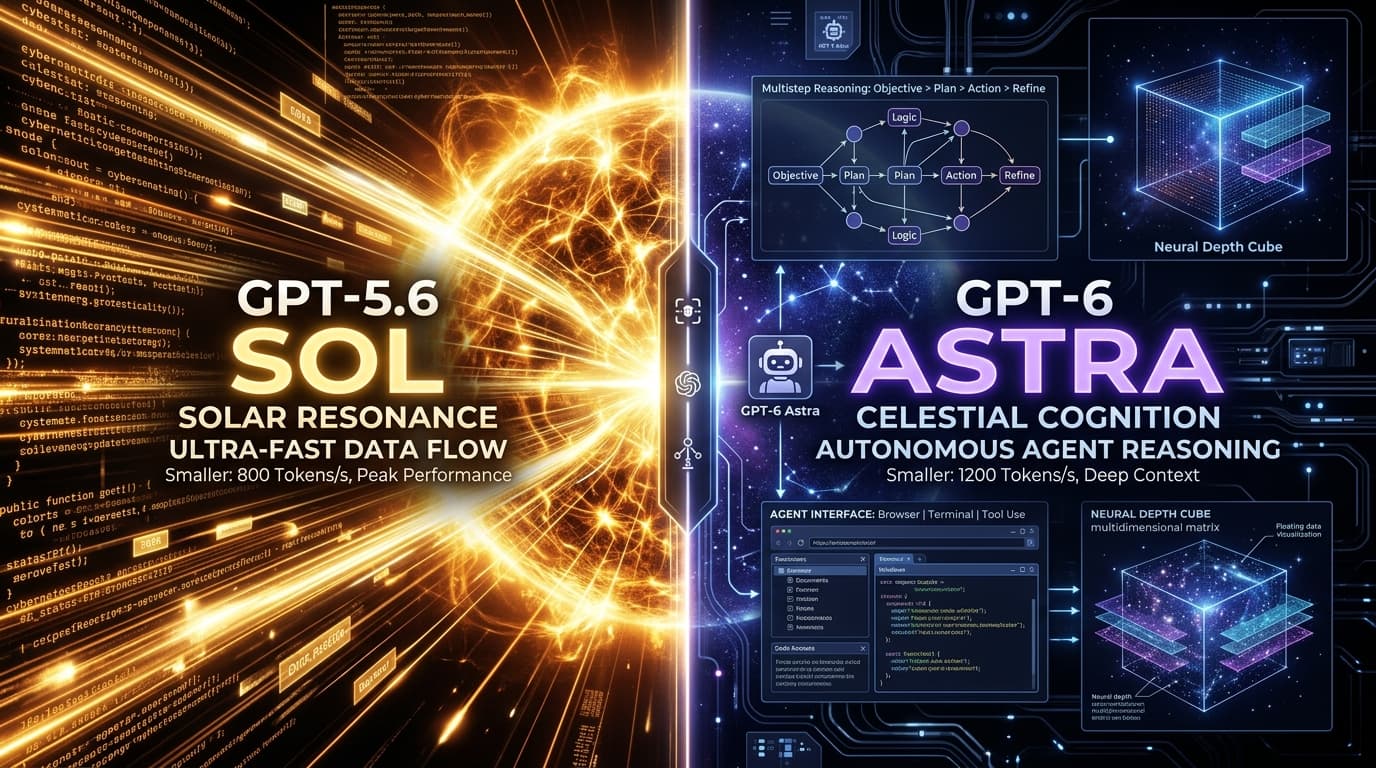
For roughly 80% of daily engineering tasks—rapid code completion, interactive debugging, and high-frequency API pipelines—GPT-5.6 Sol remains the superior, cost-effective workhorse, while GPT-6 Astra is a specialized, high-cost engine reserved for autonomous computer use, multi-hour unguided agentic loops, and extreme mathematical or architectural synthesis.
The arrival of GPT-6 Astra on September 3, 2026, did not render GPT-5.6 Sol obsolete. Instead, it split OpenAI's frontier tier into two distinct architectural categories: an agile, high-throughput daily driver versus a heavy, recurrent-depth reasoning system.
Direct Comparison: Astra vs. Sol
| Category | GPT-6 Astra | GPT-5.6 Sol | Practical Verdict |
|---|---|---|---|
| Coding | Architectural & Multi-File. Uses ~1/3 fewer output tokens on coding benchmarks via dense, concise planning; superior on zero-day vulnerability discovery, kernel-level debugging, and full repo refactors. | Interactive & Fluent. Faster inline suggestions, routine script generation, unit test writing, and continuous code review; slightly more conversational. | Sol for everyday coding and terminal autocomplete; Astra for complex, unguided multi-file refactoring. |
| Reasoning | Recurrent Depth (low to max). 97.6% on FrontierMath Tier 4 and 95.0% on ARC-AGI-2. Evaluates deep dependency trees and execution traces before emitting tokens. | Standard & Pro Tiers. 94.6% on GPQA Diamond and 92.5% on ARC-AGI-2. Strong logical deduction, but susceptible to drift on open-ended 50+ turn proofs. | Astra wins on formal verification and complex logic; Sol handles standard business and technical logic effortlessly. |
| Speed (Latency & TTFT) | Slower TTFT. Heavy test-time compute and recurrent reasoning passes introduce multi-second latency at higher reasoning efforts. (Fast mode available at 2x price). | Ultra-Low Latency. Sub-second time-to-first-token and fast token-per-second streaming; responsive in interactive IDE extensions. | Sol is significantly faster for interactive use. |
| Context Window | 1,050,000 tokens (1.05M) input, 128K maximum output. Retains sharp retrieval fidelity past 500K tokens. | 1,050,000 tokens (1.05M) input, 128K maximum output. Identical context window, with standard degradation past 400K tokens. | Tie on raw capacity; Astra holds context integrity better across multi-turn state handoffs. |
| Agentic Tasks & GUI | Autonomous Computer Use. 72.6% on OSWorld 2.0; natively drives desktop environments, browser DOMs, and terminal shells. | Function Calling & Subagents. Coordinates parallel subagents and tool calls, but lacks direct pixel-level OS navigation. | Astra is built specifically for autonomous agents and computer use. |
| Price (API per 1M tokens) | $10.00 Input / $50.00 Output ($1.00 cached input; batch at 50% discount). | $5.00 Input / $30.00 Output ($4.00/$20.00 promotional rates; $0.50 cached input). | Sol is 2x to 2.5x cheaper across standard API tokens. |
| Everyday ChatGPT UI | Slow & Heavy. Overkill for drafting emails, standard chat, or simple summaries. Prone to over-thinking simple user queries. | Fast, Natural, Intuitive. Instant conversational feedback, well-structured summaries, and rapid everyday assistance. | Sol is the vastly superior daily conversational driver. |
The Economics: The Token Cost vs. Output Efficiency Dilemma
The primary factor determining whether you should integrate Astra or Sol into production is the total cost per completed task.
At face value, Astra’s $10 input / $50 output pricing represents a 2.5x price surge over Sol’s baseline. If you feed long repository contexts into Astra—especially beyond the 272K-token threshold where long-context pricing escalates to $20 input / $75 output—unmonitored runs can burn through corporate API budgets rapidly.
Cost per 1M Tokens (Standard API):
GPT-5.6 Sol:   ████ $5 (In)  / ███████████████ $30 (Out)
GPT-6 Astra:   ████████ $10 (In) / █████████████████████████ $50 (Out) [2.5x Surge]
However, benchmark audits show that Astra uses approximately 33% fewer output tokens than Sol on multi-step coding agent tasks.
Because Astra plans its execution path internally before writing code, it avoids the conversational filler, redundant boilerplate, and trial-and-error syntax typical of older models.
- On lightweight tasks (e.g., writing a single utility function or parsing a regex), Astra's higher per-token price makes it ~75% more expensive per task than Sol.
- On massive, long-horizon tasks (e.g., migrating a 40-file React repository to modern server components), Astra’s token efficiency and lower hallucination rate (4.2% vs. 12.2% on hallucination benchmarks) offset part of the cost gap by completing the job in fewer recursive loops.
Coding and Terminal Performance: Concise Architect vs. Fast Pair-Programmer
The coding dynamic between the two models mirrors the difference between a Principal Software Architect and an agile Senior Engineer:
GPT-6 Astra: The Autonomous Systems Architect
Astra is built to run headlessly. When wired into terminal harnesses like OpenAI Codex, Claude Code, or Hermes Agent, Astra treats the terminal as a tool, not a text box. It navigates directories, inspects build logs, runs linter checks, and resolves its own errors without stalling. On cybersecurity evaluations like ExploitBench, it achieved a 100% resolution rate by dynamically rewriting proof-of-concept scripts to match memory structures.
GPT-5.6 Sol: The Interactive Co-Pilot
Sol is tuned for immediate, interactive pair-programming. Its latency is low enough that completions stream into VS Code or Cursor with almost zero perceptible delay. It handles test generation, database schema design, and standard API routes cleanly. Its main weakness is long-horizon context drift: by turn 25 of an autonomous debugging loop, Sol is more prone to losing track of subtle implicit dependencies than Astra.
The GUI and Agentic Frontier: Why Astra Owns Computer Use
If your workflow involves computer-use agents—software that needs to interact with user interfaces designed for humans—the choice is binary.
GPT-5.6 Sol relies on traditional function calling and structured API outputs. It can call a database endpoint or query a REST service, but it cannot effectively parse dynamic visual layouts, read unlabelled canvas elements, or drive desktop software.
GPT-6 Astra was trained natively on GUI interaction and computer control. Scoring 72.6% on OSWorld 2.0, it can:
- Parse complex, multi-window desktop environments across macOS and Linux.
- Visually anchor buttons and text fields on un-instrumented web applications without accessibility tags.
- Execute end-to-end user workflows—such as logging into a cloud console, configuring an IAM role, and exporting billing CSVs—entirely through browser clicks and keyboard inputs.
If an agent needs to touch a user interface, Astra is the only viable model between the two.
From the Workstation Trenches: How to Route Between Astra and Sol
Sitting at a workstation managing local agent pipelines alongside cloud endpoints, relying exclusively on either model is an anti-pattern.
Running every request through Astra burns compute budgets unnecessarily. Conversely, forcing Sol to navigate long-horizon architectural migrations leads to context drift and manual developer interventions.
The standard practice in modern development environments is a dynamic three-tier routing stack:
- Tier 1 (Local Edge - $0.00): Run quantized open-weight models (e.g., Qwen 3.6 Coder or Muse Glimmer via Ollama) on local RAM for instant syntax autocomplete, linting, and basic formatting.
- Tier 2 (High-Throughput Utility - $5/$30): Route standard application logic, test suites, API generation, and code review passes to GPT-5.6 Sol.
- Tier 3 (Frontier Escalation - $10/$50): Escalate strictly to GPT-6 Astra when the system detects multi-file architectural refactoring, unguided computer-use workflows, or complex dependency bugs that fail two consecutive test passes.
Developer Playbook: Setting Up Dynamic Routing in Code
To implement cost-efficient routing between Sol and Astra in an agentic workflow, decouple your application logic from a single model ID using an abstraction gateway.
- Configure a Model-Agnostic Gateway Client: Gateway Architecture.
Initialize an OpenAI-compatible client wrapper that accepts dynamic model parameters rather than hardcoding
gpt-6-astraacross your services:
from openai import OpenAI
import os

client = OpenAI(api_key=os.environ.get("OPENAI_API_KEY"))
- Classify Tasks by Cognitive and Visual Complexity: Heuristic Routing. Construct a dispatch function that checks whether the incoming payload requires GUI automation, deep reasoning, or standard code generation:
def select_engine(task_type: str, requires_computer_use: bool) -> str:
    if requires_computer_use or task_type in ["formal_audit", "repo_refactor"]:
        return "gpt-6-astra"
    return "gpt-5.6-sol"
- Pass Explicit Reasoning Parameters to Astra: Reasoning Effort Tuning.
When calling Astra, configure the
reasoning_effortparameter based on the task urgency. Uselowfor time-sensitive tasks to reduce latency, and reservehighormaxfor offline batch jobs:
response = client.chat.completions.create(
    model=select_engine("repo_refactor", requires_computer_use=False),
    messages=[{"role": "user", "content": "Refactor the auth middleware."}],
    reasoning_effort="medium" # low, medium, high, xhigh, max
)
- Enable Prompt Caching for Long Repositories: Cache Optimization.
Ensure repository context and
.cursorrulesare passed in static prefix blocks to trigger OpenAI’s $1.00/1M cached input rate on Astra ($0.50 on Sol), slashing your effective input token spend by up to 90%.
The Verdict
Choose GPT-5.6 Sol if you need:
- Responsive, low-latency code completion inside your IDE.
- High-volume API processing where a $50/1M output cost is commercially unviable.
- Everyday conversational queries, writing assistance, and fast script generation.
Choose GPT-6 Astra if you need:
- Autonomous computer use, browser automation, and desktop GUI navigation.
- Deep, unguided multi-file refactoring where token efficiency and low hallucination matter more than raw speed.
- Research-tier mathematics, formal verification, or automated security exploit testing.
For the vast majority of engineering workflows, Sol is the engine that writes your software today—Astra is the autonomous agent you deploy when you want the machine to operate the computer for you.