For the past three years, the dominant narrative in artificial intelligence convinced us that intelligence is exclusively a game of planetary-scale brute force.
We were told that if you wanted to generate coherent language, you had to route your data to a multi-gigawatt data center packed with liquid-cooled graphics clusters, pay a continuous API token toll, and accept the multi-second latency of cloud round-trips. The assumption was simple: microcontrollers are for blinking LEDs and reading temperature sensors; large language models are for supercomputers.
In August 2026, an open-source developer named slvDev completely detonated that assumption.
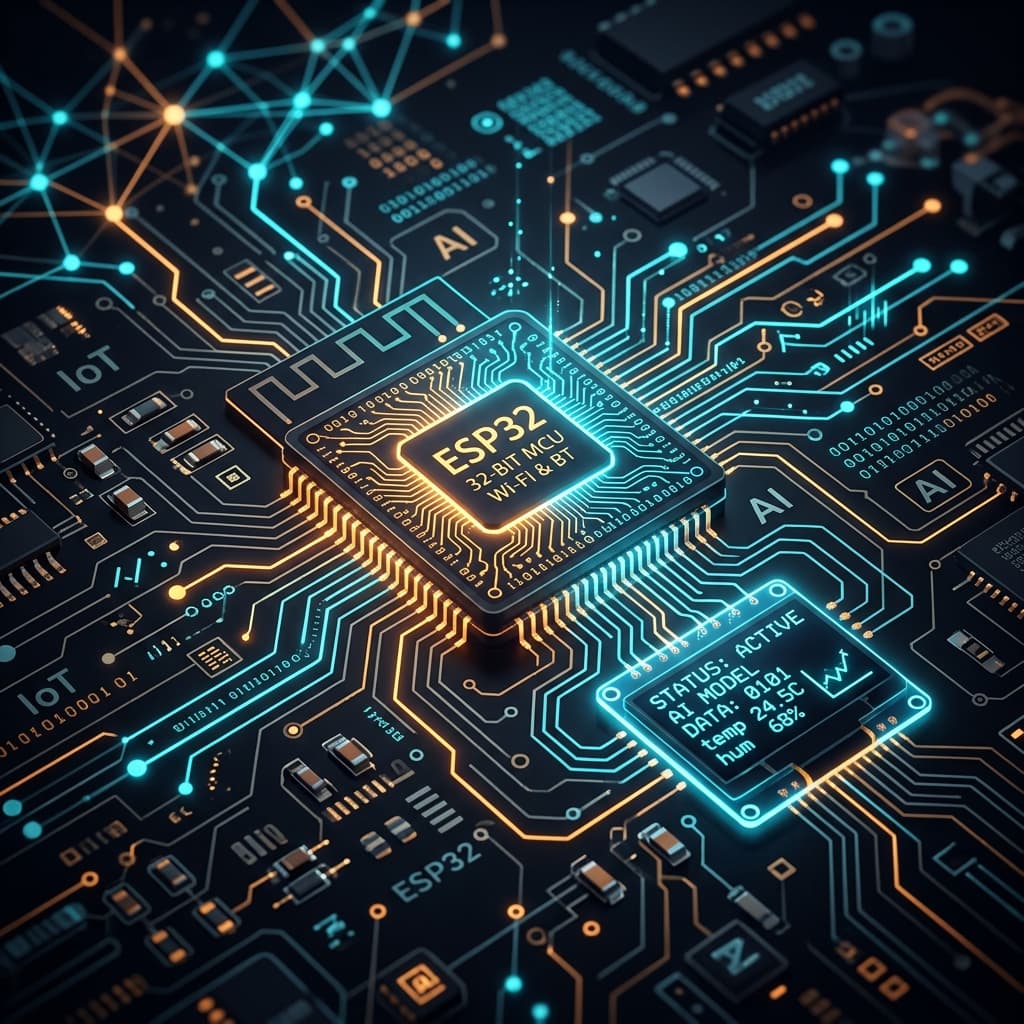
With a project called esp32-ai, they managed to squeeze a 28.9-million-parameter language model onto an ESP32-S3—a bare development board that costs roughly $8 to $10—and got it generating text completely offline at nearly 10 tokens per second (9.88 tok/s), outputting directly to a small attached display with zero internet connection.
To put this achievement into perspective: the previous ceiling for running language models on this tier of embedded hardware was roughly 260,000 parameters. This project didn't just push the boundary by 10%—it expanded it by more than 100x.
This isn't just a quirky hardware hack to post on Hacker News. It is a massive milestone that connects AI, IoT, embedded systems, and extreme quantization—and it gives us a glimpse into a future where sovereign intelligence runs on physical devices everywhere.
The Memory Tier Hack: How to Fit 28.9M Parameters into 512 KB
To understand why this is an engineering masterclass, you have to look at the physical memory wall of embedded microcontrollers.
An ESP32-S3 is a tiny dual-core Xtensa chip running at 240 MHz. It has 512 KB of internal SRAM, 8 MB of external SPI RAM (PSRAM), and 16 MB of SPI Flash storage.
In standard transformer inference (like running a model on a PC GPU), the entire neural network must live inside ultra-fast memory because the processor computes matrix multiplications across every single weight for every single generated token. If you try to load a 28.9-million-parameter model the traditional way, even with 4-bit quantization (compressing the model to 14.9 MB), you crash into an immediate hardware wall: the fast SRAM is 30 times too small, and the PSRAM is half the size of the model.
The developer solved this by borrowing a technique inspired by Google’s Per-Layer Embeddings (PLE) from the Gemma family (specifically explored in the Gemma 3n architecture):
- SRAM (512 KB): Holds only the high-frequency values touched dozens of times per token—specifically the active intermediate activations and normalization weights.
- PSRAM (8 MB): Houses the dense computational attention core and the output projection head, which are scanned once per token position.
- Flash Memory (16 MB): This is the magic trick. Instead of treating the 25-million-parameter embedding table as dynamic compute memory, the system leaves it on the slow 16 MB flash chip. During generation, the model doesn't compute across the whole table; it performs an exact lookup, pulling only ~6 rows (roughly 450 bytes) per token.
Because 85% of the model lives in flash and is only sampled a few hundred bytes at a time, the model runs smoothly without ever exceeding the microcontroller’s tiny RAM limits.
The Reality Check: What It Does (and What It Doesn't)
We need to be technically honest about what a 28.9M parameter model running on an $8 chip can actually do.
The base model was trained on Microsoft's TinyStories dataset. It is essentially a "micro-language model." It writes simple, coherent children’s stories, maintains grammatical consistency, and streams text to an attached SPI screen at a crisp 9.5 to 10 tokens per second.
It will not solve complex algorithmic puzzles, write Python scripts, or answer general trivia. It is bounded by the small size of its reasoning core.
However, the repository also includes a "Barista" espresso model—a domain-specialized checkpoint fine-tuned exclusively to answer questions about coffee beans, grind sizes, water temperatures, and extraction ratios. And that is where the real commercial revolution begins.
The IoT Paradigm Shift: Why This Changes Embedded Systems
For the past decade, the "Smart Home" and industrial IoT sectors have been fundamentally broken by cloud centralization.
Every time you buy a "smart" appliance—a washing machine, an air conditioner, a greenhouse sensor, or a coffee maker—it requires a companion mobile app, a Wi-Fi connection, user account registration, and continuous data transmission to a remote server. If your internet goes down, your smart device turns into a dumb brick. If the manufacturer shuts down its cloud servers five years later, the hardware ends up in a landfill.
| IoT Architecture Vector | Cloud-Tethered "Smart" Device | Sovereign On-Chip Edge AI (ESP32-S3) |
|---|---|---|
| Connectivity Requirement | Continuous 24/7 internet/Wi-Fi connection mandatory. | Zero. Operates 100% offline in isolated environments. |
| Operational Cost | Recurring cloud server bills and API token costs. | $0.00. Fixed hardware cost ($8–$10 one-time). |
| Data Privacy | High risk; voice audio and sensor logs sent to the cloud. | Absolute. Raw signals never leave local silicon. |
| Failure Modes | Network dropouts, API rate limits, server deprecation. | Runs continuously as long as the device has electricity. |
| Latency Profile | Variable (500ms – 3000ms cloud network hops). | Sub-100ms deterministic local token generation. |
By running domain-specific micro-LLMs directly on sub-$10 chips, we can build appliances and industrial hardware that possess offline natural language intelligence:
- The Sovereign Coffee Machine: A machine with an embedded 28M Barista model that diagnoses extraction problems, explains grind adjustments, and provides brewing guidance entirely offline—no app, no account, no cloud telemetry.
- Agricultural & Environmental Edge Nodes: In remote farming regions where cellular connectivity is intermittent or non-existent, an ESP32 wired to soil moisture and weather sensors can generate plain-language diagnostic summaries ("Soil nitrate levels dipping in Sector 4; delay irrigation until 6 PM") on a local e-ink display.
- Industrial Safety Interlocks: Embedded machinery that explains fault codes and troubleshooting steps directly to field technicians on an integrated screen without requiring an internet connection inside shielded factory floors.
From the SLIIT Trenches: Tinkering at the Hardware-AI Boundary
Sitting at my workstation late into the night here in Sri Lanka—balancing Information Technology degree modules specializing in Artificial Intelligence at SLIIT with real-world software builds—this microcontroller breakthrough hits with immediate personal clarity.
When you spend your time building automation pipelines, training models, and participating in IoT challenges (like prototyping sensor nodes with microcontrollers), you quickly realize that computing is defined by physical boundaries.
On my primary workstation—an MSI Cyborg laptop upgraded with 28GB of DDR5 RAM—I spend hours pushing local inference on models like Qwen 3.6, DeepSeek, and Meta's Muse Glimmer using Ollama. That setup gives me absolute developer sovereignty on my desk.
Seeing slvDev push a 28.9M model onto an $8 ESP32-S3 proves that local AI is not restricted to high-end laptops or expensive graphics cards.
The same architectural principles—aggressive 4-bit quantization, tiered memory offloading, and domain-specific distillation—scale all the way down from massive data centers to a chip the size of a postage stamp running on a $2 solar cell in a field.
The Developer Playbook: How to Explore Embedded Micro-LLMs
If you want to experiment with running language models on embedded silicon, here is the technical workflow to get started:
-
Acquire an ESP32-S3 with External PSRAM: Hardware Selection. Ensure you are using an ESP32-S3 development board equipped with at least 8 MB of Octal PSRAM and 16 MB of Flash memory (such as the ESP32-S3-DevKitC-1 N16R8). Standard ESP32 chips lacking PSRAM will run out of memory during initialization.
-
Configure the ESP-IDF Environment: Toolchain Setup. Install the official Espressif IoT Development Framework (ESP-IDF v5.x) and set up the compilation toolchain on your workstation to support C/C++ embedded builds.
-
Download and Prepare 4-bit Weights: Model Quantization. Clone the
slvDev/esp32-airepository. Pull the pre-trained 28.9M checkpoint (TinyStories or Barista) and use the included export script to generate the 4-bit quantized binary partition (model.bin, ~14.9 MB). -
Flash Firmware and Model to Storage Tiers: Partition & Flash. Configure the custom partition table allocating 15 MB for the model partition on flash. Flash the compiled firmware to SRAM/PSRAM addresses and write the weight binary directly to the flash partition via USB.
The Horizon: Intelligence Everywhere
Putting a 28.9M parameter model on an ESP32-S3 marks a profound shift in how we should think about the deployment of artificial intelligence.
For years, the technology industry suffered from a collective failure of imagination, assuming that every single AI interaction required sending bytes across the globe to a trillion-parameter cloud monolith.
The open-source community is proving that intelligence is a continuum.
We need massive frontier models in the cloud for high-level architectural reasoning. We need 14B and 30B open-weight models running on our laptops for private, high-speed coding. And we need 28M micro-models running on $8 microcontrollers to give a voice to the physical objects in the world around us.
The monopoly on intelligence has broken—all the way down to the microcontroller on your desk.