We have officially hit the inflection point where AI stops telling you how to do things and simply starts doing them for you.
For the past few years, the evolution of consumer artificial intelligence has followed a predictable, almost linear product roadmap. We started with basic text chatbots that answered static questions, advanced into semantic search tools, and then witnessed the multimodal explosion of AI-generated images and hyper-realistic video clips. It was an incredible run of pure content generation, but at the end of every single session, you were still the one closing the tab, opening your workspace tools, and manually translating that AI output into actual operational results.
But on July 9, 2026, the boundary between text prompt and software execution was permanently dismantled.
Alongside the formal launch of the high-reasoning GPT-5.6 "Sol" model family, OpenAI dropped a massive product integration layer into the enterprise world: ChatGPT Work.
This isn't a new model iteration or a subtle UI update. It is a completely autonomous agentic mode designed to transform the world’s most famous chatbot from a reactive sounding board into a 24/7 digital coworker that executes multi-hour projects across your entire professional application stack.
For anyone tracking the developer landscape, this feels like Claude on steroids. We watched the technical community lose its mind over Anthropic’s Model Context Protocol (MCP) integrations—building custom flows where Claude could edit videos, update local servers, or orchestrate marketing scripts. But while Anthropic gave us the protocol infrastructure to build our own bridges, OpenAI just dropped the native, out-of-the-box powerhouse. Autonomous GPT has officially entered the chat, and the workspace will never look the same.
The Shift: From Short Sessions to Eight-Hour Shifts
The core technical shift underpinning ChatGPT Work is the transition from transient, short-context conversational turns to long-horizon task delegation.
According to OpenAI's internal usage telemetry tracking productivity frameworks, the fundamental unit of machine work has completely fractured. Traditional chatbot interactions are transactional—they wrap up within 5 minutes. With the deployment of agentic environments like ChatGPT Work, the operational duration has skyrocketed.
Data from OpenAI's developer research reveals that over 42.4% of all agent turns are now deployed to manage tasks that take more than 4 hours of continuous human time to execute, with a massive 25.6% scaling past the 8-hour shift threshold.
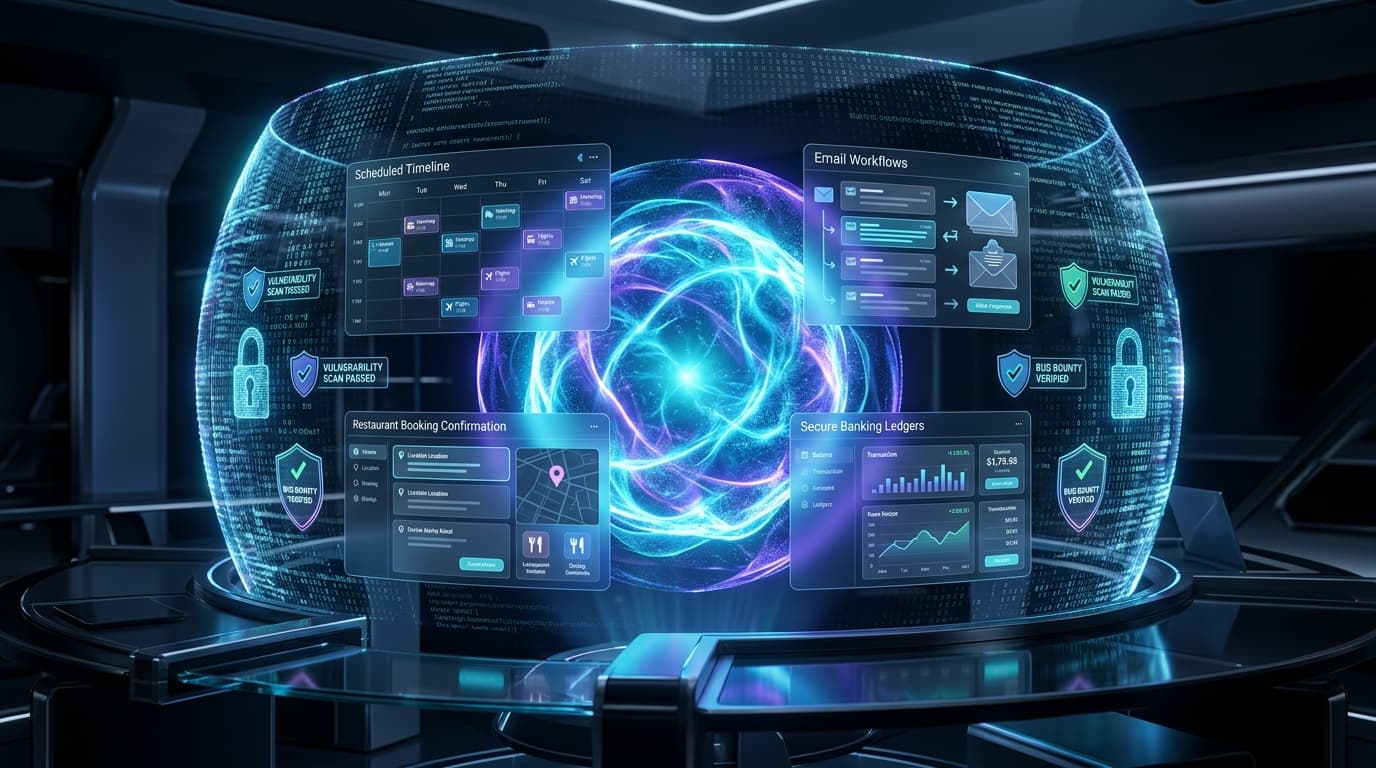
Instead of baby-sitting a window, an enterprise professional can drop a high-level strategic goal—like compiling a comprehensive financial audit, extracting data parameters from separate files, mapping them to a master sheet, and formatting a presentation deck—and walk away while the backend model loops silently across tools like Zapier, RingCentral, Google Drive, and SharePoint to build the finished asset from scratch.
Tasting Agency in the Local Sandbox
When you sit at a development desk late into the night—running on a highly customized setup like an MSI Cyborg laptop packed with 28GB of DDR5 RAM—this transition to agentic autonomy hits with immediate, personal significance.
For the past few months, I have been actively experimenting in the trenches with self-hosted orchestration tools like OpenClaw to build my own localized "ghost teams." I constructed and deployed a collection of autonomous specialized agents:
- Hana: An agent built exclusively to track tech developments, parse technical documentation, and draft structured blog copy.
- Zero: A codebase script executor designed to analyze directory layouts, refactor components, and write unit tests.
- Sakura: A high-level orchestration graph acting as the workflow manager to pass context back and forth between Hana and Zero.
If you have ever tried to keep a multi-agent system like that running locally for hours, you know the absolute physical limits of modern consumer setups. Your processor cores max out instantly, your laptop fans hum like a jet engine trying to keep up with the continuous vector database loops, and your cloud API token credit line burns down rapidly as the agents run recursive self-correction cycles across your local directories.
But even when you hit those hardware boundaries, the sheer experience of agentic capability is completely transformative. It gives you a profound taste of the future.
And if a developer can orchestrate that level of parallel execution on a single local laptop, it forces a massive realization about what is currently happening inside the premier research labs at OpenAI and Anthropic. Behind closed doors, their internal teams are almost certainly running massive, thousands-deep synthetic agent swarms where the machines are handling 99% of the heavy pretraining research, codebase refactoring, and data curation—keeping human engineers strictly at the high-level steering wheel as qualitative orchestrators.
The Operational Flow: Inside the Integration Layer
ChatGPT Work achieves this level of task stability because it embeds OpenAI's Codex framework directly into the root workspace app layer, effectively converting the system into a unified superapp.
When a user issues a broad project goal, the agentic engine bypasses simple text generation entirely and executes a structured, multi-step orchestration pipeline:
-
Deconstruction and Goal Allocation: Step 1: Planning Loop. The core GPT-5.6 Sol engine ingests the high-level objective, maps out a dependency graph of subtasks, and assigns clear criteria for what constitutes a successful execution trace.
-
Ecosystem Authentication and Context Scraping: Step 2: Tool Registry Activation. The agent calls secure first-party plugins to establish data pipelines across connected enterprise tools, indexing documents, extracting parameters from files, and reading messaging histories.
-
Asynchronous Execution and Synthesis: Step 3: Sandboxed Action. The system spins up parallel execution steps—directing subagents to build spreadsheets, compile code assets, format marketing copy, and construct presentation modules concurrently inside secure sandboxes.
-
Self-Correction and Final Compilation: Step 4: Verification Gate. The agent triggers automated internal verification checks to verify format compliance, fix code syntax failures, and cross-reference data accuracy before compiling the separate pieces into a complete, ready-to-use project deliverable.
The Great Corporate Paradox: Privacy vs. Capability
Despite the immense productivity excitement flooding enterprise forums, the rollout of ChatGPT Work has triggered an intense, highly systemic privacy controversy across corporate IT infrastructure.
For a traditional chatbot, data safety is a manageable problem because the model’s exposure is completely limited to whatever text block you explicitly choose to copy-paste into the prompt box. An autonomous workspace agent, by definition, requires completely uninhibited, deep-seated access to your digital ecosystem to perform long-horizon work.
| Operational Axis | Standard Conversational Chatbots | ChatGPT Work Autonomous Architecture |
|---|---|---|
| Data Ingestion Model | Explicit, user-initiated text snippets and file attachments. | Persistent tracking of connected drives, communication logs, and local directories. |
| System Permission Scope | Confined strictly to an isolated browser runtime sandbox. | High-level tool access tokens capable of modifying app states and file structures. |
| Data Security Standard | Supports Zero Data Retention (ZDR) mode for strict corporate compliance. | Requires a rolling 30-day logging window to continuously evaluate classifier safety. |
| Operational Execution | Generates text outlines that require manual human follow-through. | Executes complex multi-step pipelines natively across cross-platform environments. |
This architectural reality has created a massive bottleneck for enterprise adoption. Because the model must continuously read, index, and analyze live files to track background schedules, the security perimeter shifts completely.
If the agent processes an external data source that contains a malicious prompt-injection attack, it could theoretically be manipulated into executing unauthorized actions, corrupting adjacent file structures, or leaking sensitive authentication tokens to external servers. It is exactly why security-conscious organizations are currently halting employee usage—realizing that when an AI tool gains the agency to act on your behalf, it simultaneously becomes a massive, unpredictable vector for systemic risk.
The Horizon: Shifting from Builders to System Directors
The acceleration of the agentic web means that the historical value metric of an IT professional or a digital creator has officially expired. If your strategy for the future is simply being a human translator—taking a basic requirement and manually typing out standard syntax, basic documents, or routine marketing copy line-by-line—you are directly competing with a zero-marginal-cost machine worker that doesn’t sleep.
The industry is rapidly dividing into two groups: those who are being automated out of the execution loop, and the system directors who know how to command the swarm.
To stay ahead of this cycle, our development and operational habits must evolve immediately. Stop wasting your creative energy handling routine operational plumbing. Instead, focus entirely on system architecture, semantic context design, and programmatic verification. Master the art of configuring strict, declarative tool parameters, engineering automated testing frameworks, and managing insulated execution sandboxes. The tools have evolved from passive helpers into hyper-capable coworkers—and the builders who win this next era will be the ones who know exactly how to direct them.