The fantasy of the AI era is that you download an open-source framework, write a short configuration file, and suddenly a fleet of digital geniuses perfectly executes your workload. The reality—as any developer or AI student knows—is usually a brutal sequence of API rate limits, terminal errors, and late-night architectural overhauls.
Following my initial 48-hour battle migrating OpenClaw out of root and fixing permission states, I spent the next 48 hours dealing with a much more complex problem: behavioral alignment and multi-agent coordination.
As of 3:00 AM last night, the infrastructure is finally stable. I have successfully architected a local, three-agent virtual micro-studio running on my machine. They don't just process text; they run continuous code integrations, monitor macro tech trends, manage independent publication spaces, and cover for each other's execution failures.
If you are looking to move past simple single-turn prompts and build actual operational leverage, here is how my three digital co-workers are configured, how they handle my repository pipelines, and why my next experiment might completely break them.
The Virtual Studio Roster
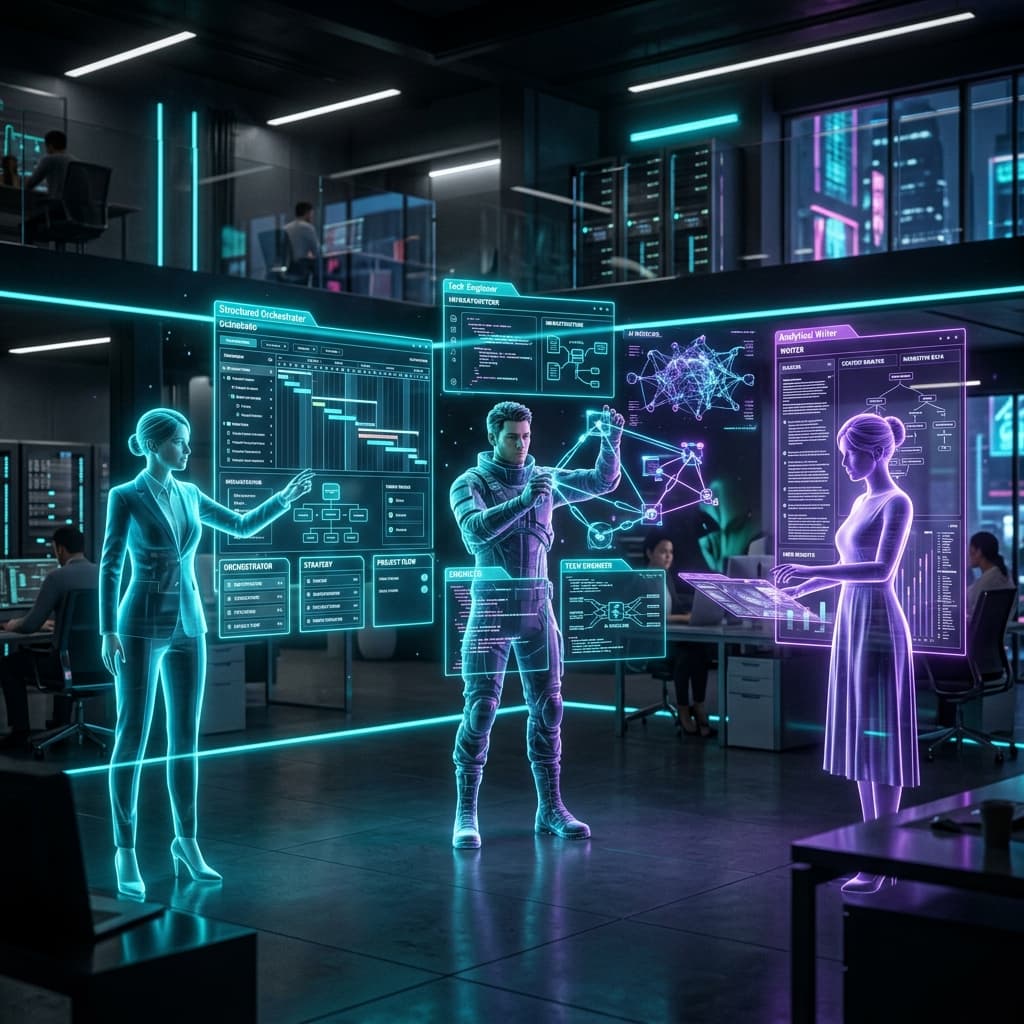
To make a multi-agent system reliable, you cannot rely on generic, one-size-fits-all prompts. You have to design hyper-specific roles, backstories, and operational constraints. My local OpenClaw workspace is now governed by three distinct entities:
- Sakura (Age 23) — The Orchestrator & Assistant: Her prompt configuration defines her as highly structured, a little bossy, but fiercely responsible. She acts as the central control plane, managing communication handoffs, tracking state dependencies, and monitoring execution anomalies.
- Zero (Age 22) — The Lead Engineer: Outspoken, hyper-confident, and structurally aggressive. His core instruction profile dictates that "nothing is impossible to engineer." He has full file-system tool access to my development workspace.
- Hana (Age 25) — The Trend Writer: Systemically configured as quiet and slightly analytical, but possesses an elite semantic synthesis profile. She doesn't write standard marketing fluff; she tracks macro technical shifts and writes deep-dive analytical copy.
The Repository Pipeline: Continuous Integration via Agent Handoffs
The first structural task I assigned to this team was the continuous optimization of HabitCal, a high-performance, calendar-first routine planner application I’ve been refining. I wanted the repository to receive daily iterative improvements without my direct manual intervention.
To achieve this, I engineered a multi-turn handoff loop between Sakura and Zero.
As illustrated in the software delivery workflow above, the pipeline operates as a structured, automated circle:
- Session Initiation: Sakura triggers a session, clones the target repository into an isolated local workspace directory, and conducts a structural audit of the current codebase.
- Task Delegation: Sakura identifies potential architectural improvements or optimization targets and hands off the context token to Zero.
- Execution & Testing: Zero takes the codebase, modifies the logic, and runs local compilation and test validation passes inside his environment.
- Verification: Zero packages the functional changes, compiles a changelog, and opens a formal Pull Request (PR) on the local repository. Sakura then generates a concise system summary and delivers it directly to my personal dashboard.
The Failover Mechanism: Graceful Exception Handling
The real-world value of this setup isn't just when it runs perfectly—it's how it behaves when the underlying infrastructure fails. During early test runs, Zero frequently hit a wall when dealing with external dependencies, specifically throwing unhandled exceptions whenever Google API rate limits or authentication timeouts occurred. Left unsupervised, a standard coding agent will simply loop, burn tokens, and crash the session.
To fix this, I implemented an escalation policy inside OpenClaw. Now, when Zero encounters a systemic environment error or an API quota lockout, the session state automatically hands control back to Sakura.
Sakura intercepts the exception, places Zero's execution thread on a contextual pause, calculates the backoff window required by the Google API, manages the credential re-handshake behind the scenes, and safely resumes the engineering loop once the environment clears.
The Content Architecture Pivot: Unlocking Autonomy for Hana
The second major bottleneck I hit involved content generation. Initially, I had Sakura pass raw technical data logs from Zero's coding sessions to Hana, instructing her to write descriptive summaries of our development updates.
The output was incredibly underwhelming. Because she was forced to summarize someone else's minor code updates, the articles read like rigid, robotic patch notes. It lacked the creative spark that makes tech blogs worth sharing.
Realizing the mistake, I completely re-architected my blogging platform. I refactored the backend code of my site to support a multi-author CMS model and built a dedicated, permanent "About" profile page entirely for Hana. Instead of treating her like a technical documentarian, I gave her full creative autonomy as an independent writer.
Her new directive is completely independent: parse the global web, track daily shifting macroeconomic tech trends, evaluate emerging frameworks, and publish exactly three unique, high-density articles every single day under her own author entity. Seeing her navigate current industry debates and consistently deliver highly structured, analytical pieces directly to the site database has completely shifted how I view decentralized content production.
The Next Friction: The Group Chat Social Experiment
With both pipelines executing smoothly, I am now staring down a brand-new architectural hurdle.
Right now, my agents communicate strictly through linear, point-to-point session handoffs managed by the OpenClaw daemon (User -> Sakura -> Zero -> Sakura -> Hana). While safe, this creates a siloed pipeline. I want to see what happens when you remove the rigid sequence and force them into a shared, event-driven mesh network—essentially an ongoing, real-time brainstorming group chat.
The problem? You can't just spin up a standard Telegram or Slack group chat, invite three bot tokens, and expect them to collaborate effectively. Without a strict orchestration primitive, one of two things happens instantly:
- The Deadlock: Every agent waits for another agent to speak first, causing the thread to hang indefinitely.
- The Token Cascade: Zero postulates an engineering theory, Hana writes a massive article analyzing it, Sakura criticizes the format, which triggers Zero to write more code, creating an infinite, self-referential conversational loop that burns through my API credits in minutes.
To make a group environment work, I’ll need to implement a custom Shared Blackboard or Peer-to-Peer messaging broker layer within my local OpenClaw gateway config. The agents will need an asynchronous message-passing system where they can actively listen to a single chat stream, but can only assert a response when a specific "turn-taking" condition or structural event cue is triggered.
It is officially past 3:00 AM. The terminal is clean, the API limits have finally reset, and tomorrow morning I start building the custom group chat protocol. Let’s see if this team can survive talking directly to one another without crashing the local server. Full system architecture and configuration diffs are coming in the next post.