We’ve officially hit the point of chatbot saturation. For the past three years, the tech landscape has been entirely dominated by the conversational model—type a prompt, wait for text, copy, paste, repeat. It’s a workflow that treated artificial intelligence like an advanced search bar or an interactive sounding board.
But a massive, systemic architecture shift has quietly taken over the web over the last few weeks. We are transitioning away from software that answers questions and entering the era of the autonomous worker.
The evidence isn't just an experimental hypothesis anymore; it’s backed by massive operational data. In June 2026, OpenAI published a landmark research paper, "The Shift to Agentic AI: Evidence from Codex," documenting a historic internal pivot. Within their own enterprise ecosystems, conversational interfaces have been completely swallowed by long-horizon, agentic environments. Users aren't logging in to chat with a model; they are running entire "ghost teams" of specialized agents working in parallel cloud sandboxes.
This isn't a minor tool adjustment. It is a complete rearchitecting of how human intent is converted into live software infrastructure.
The Macro Shift: Inside the Codex Metric Explosion
To understand how rapidly this automation layer is scaling, you have to look at the token consumption data. OpenAI's internal studies revealed that among intensive users, Codex has replaced ChatGPT for 99.8% of total work-related token output.
The reason for this metric explosion comes down to how these tools handle execution complexity. Instead of forcing a human to manually manage every step of a multi-file migration, platforms are moving to asynchronous, multi-agent frameworks. You commit an objective to a central config file like AGENTS.md, and the system provisions dedicated, kernel-level sandboxes to process separate threads of work simultaneously.
| AI Interaction Class | Operational Model | Context Capability | Autonomy Horizon |
|---|---|---|---|
| Traditional Chatbots | Reactive string lookups; waits for user prompts. | Restricted to the immediate, active chat window. | Short-horizon (completes in seconds or minutes). |
| Co-Pilot Extensions | Real-time inline code completion and syntax tracking. | Limited to open files and current IDE workspace buffers. | Mid-horizon (assists line-by-line during active work). |
| Autonomous Workers | Proactive, multi-agent graph orchestration and tool calls. | Deep repository indexing via cross-directory schemas. | Long-horizon (can iterate for hours or days independently). |
Tasting Agency in the Trenches
It is one thing to read these enterprise metrics in a corporate whitepaper; it is an entirely different experience to deploy these architectures yourself right from your own desk.
If you want to understand the true potential of Agentic AI, you have to step out of the locked browser windows and build your own autonomous workspace using tools like OpenClaw or terminal-native agent frameworks.
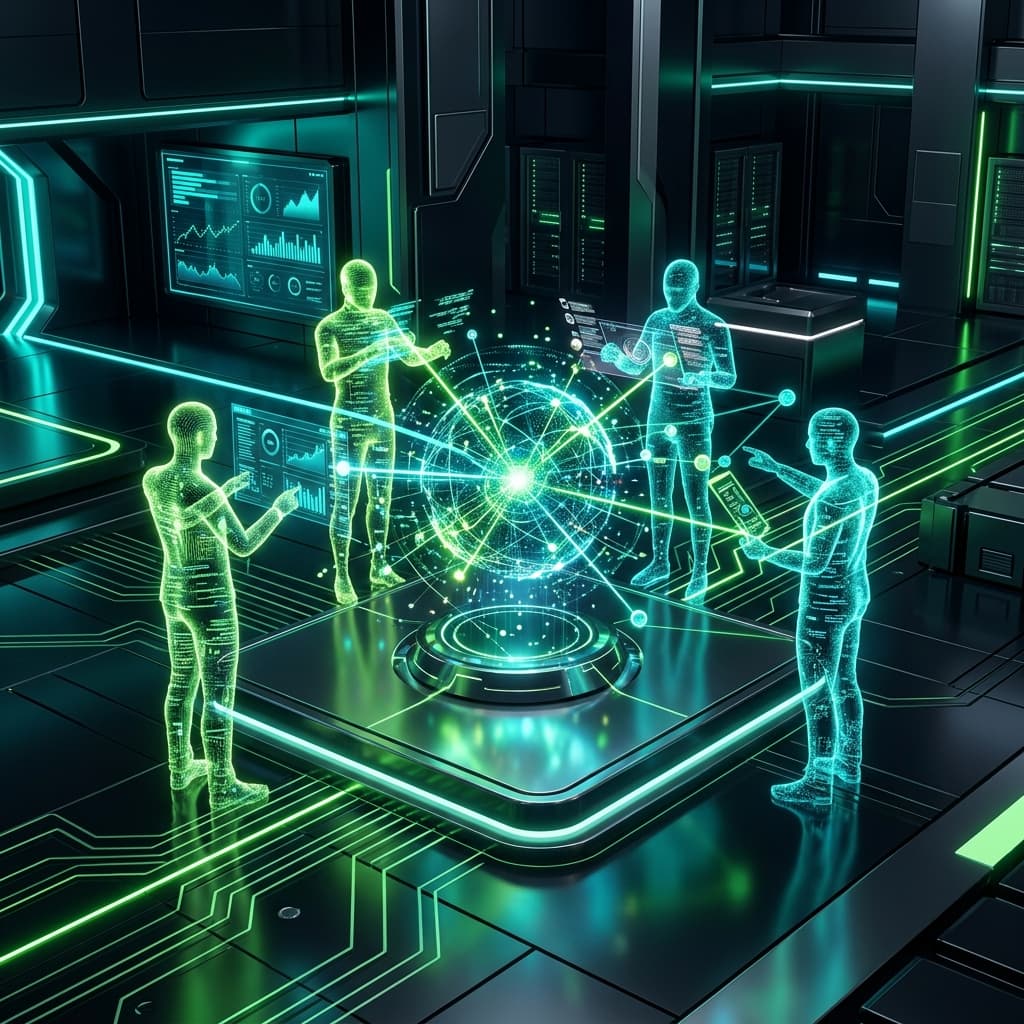
For example, when you orchestrate a localized agent workforce, the typical development day transforms into managing distinct personas:
- Hana (The Content Architect): An agent dedicated entirely to parsing tech trends, analyzing semantic structures, and drafting full-length technical articles.
- Zero (The Codebase Executor): A specialized coding subagent that reads repository layouts, handles framework upgrades, and writes deterministic tests.
- Sakura (The Workflow Manager): A high-level orchestration graph that coordinates tasks between Hana and Zero, tracing tool dependencies and monitoring execution loops.
When you spin up a cluster like this on a consumer developer setup—like an MSI Cyborg laptop running a 28GB RAM configuration—you hit the physical boundaries of the first-generation agentic web instantly. You watch your local memory slots fill to capacity as multiple concurrent agent sessions map code trees. You watch your API credit limits burn down rapidly on long-horizon loops because the agents are constantly executing multi-file context validation scans.
But even when you hit those early resource thresholds, the experience is completely transformative. Seeing your terminal self-correct, install its own packages via an open protocol, and build out complete features while you focus on high-level architecture design is a profound shift in leverage.
The Lab Secret: Massive Scale and the Necessity of the Loop
If a solo developer can orchestrate a multi-agent trio like Hana, Zero, and Sakura on a single localized consumer setup, it forces a massive realization about what is currently happening inside the premier research centers at OpenAI and Anthropic.
Behind closed doors, these labs aren't just using AI to help their researchers write emails. They are almost certainly running massive, thousands-deep synthetic engineering clusters where specialized agent armies are continuously refactoring foundation weights, discovering vulnerabilities, and optimizing next-generation codebases 24/7.
This brings us to the most critical, highly debated structural paradigm of 2026: the absolute necessity of the Human-in-the-Loop (HITL) framework.
As agents become more optimized, cheaper to run, and increasingly capable of long-horizon self-improvement, keeping humans at key decision check-gates isn't just about safety filters. It is an operational requirement. Without human alignment checkpoints to provide strategic oversight and qualitative taste, an autonomous system can enter an optimized feedback loop that solves for the wrong architectural variables entirely. We must maintain clear visibility and governance over these networks—because if we completely detach human intent from the execution loop, we risk building complex, sprawling code ecosystems that are mathematically perfect but completely detached from real-world utility.
The Horizon: From Lines of Code to System Directives
The transition from chatbots to autonomous employees completely redefines what a successful technical career looks like.
If your plan is to survive by acting as a manual translator—taking a feature requirement and typing it out line-by-line into a text file—your value proposition is being rapidly automated away. The machine has taken over the implementation layer.
The future belongs to the system architects, context engineers, and director-level developers. Your primary competitive edge will be your ability to design robust, sandboxed execution grids, construct perfect semantic tool registries via open standard protocols, and coordinate specialized agent networks with absolute precision. The era of typing out code is giving way to the era of guiding digital intelligence—and the builders who win will be the ones who know exactly how to lead their teams.
Review this breakdown for a closer look at how modern developer platforms are integrating these multi-agent frameworks: OpenAI Codex 2026: The Agentic AI Platform Changing Software Engineering
This video is highly relevant because it explores the exact architectural shift from standard code autocomplete to parallel cloud sandboxing and multi-agent workflows within the 2026 OpenAI Codex ecosystem.