For the last fifteen years, growing a presence on YouTube has followed a predictable, almost mechanical playbook. You spend hours agonizing over a high-contrast thumbnail, stuffing your description with hyper-optimized meta keywords, and engineering a dramatic title designed to exploit human curiosity. You optimize for the algorithm, hoping that standard Video SEO will land you in the top three slots of a static search grid.
That playbook is currently being dismantled.
With the rollout of Google’s conversational AI feature, Ask YouTube, the platform is completely replacing traditional, keyword-reliant lookups with fluid, natural language queries. Instead of typing fragmented terms like "lofi coding music 2026" or "premiere pro audio fix," users can now ask complex, conversational questions like, "Find me a deep, atmospheric electronic track with a late-night vibe that won't distract me while I write code" or "Skip the intro and show me exactly how to fix a scratchy mic line in Premiere".
Looking at this shift through the dual lens of an AI developer and a digital content creator, it is clear that YouTube AI Search isn't just a minor UI update. It fundamentally upends how digital assets—whether they are technical tutorials or indie music tracks—are discovered, consumed, and monetized.
The Architectural Paradigm Shift
To understand why this changes everything for the Creator Economy, you have to look at how the underlying search architecture behaves. Traditional search matches user string inputs against metadata. AI-native search leverages Large Language Models (LLMs) to synthesize information across the entire video catalog, generating a structured text summary accompanied by precisely timestamped video clips.
| Discovery Dimension | Old Era: Metadata Keyword Search | New Era: Conversational AI-Native Search |
|---|---|---|
| Search Input | Fragmented key terms ("best coding IDE", "ambient mix") | Natural language queries ("show me user reactions comparing Claude to GPT") |
| Platform Output | A ranked grid of video titles and custom thumbnails | A synthesized text answer with inline, timestamped deep-links |
| Primary SEO Target | Title structures, meta tags, and description keyword density | Audio transcription accuracy, semantic clarity, and informational density |
| Viewer Consumption | Starts at 0:00, navigating through creator intros and hooks | Hover-to-play segments that jump directly to the answer |
The Controversy: The Great Timestamp Trap
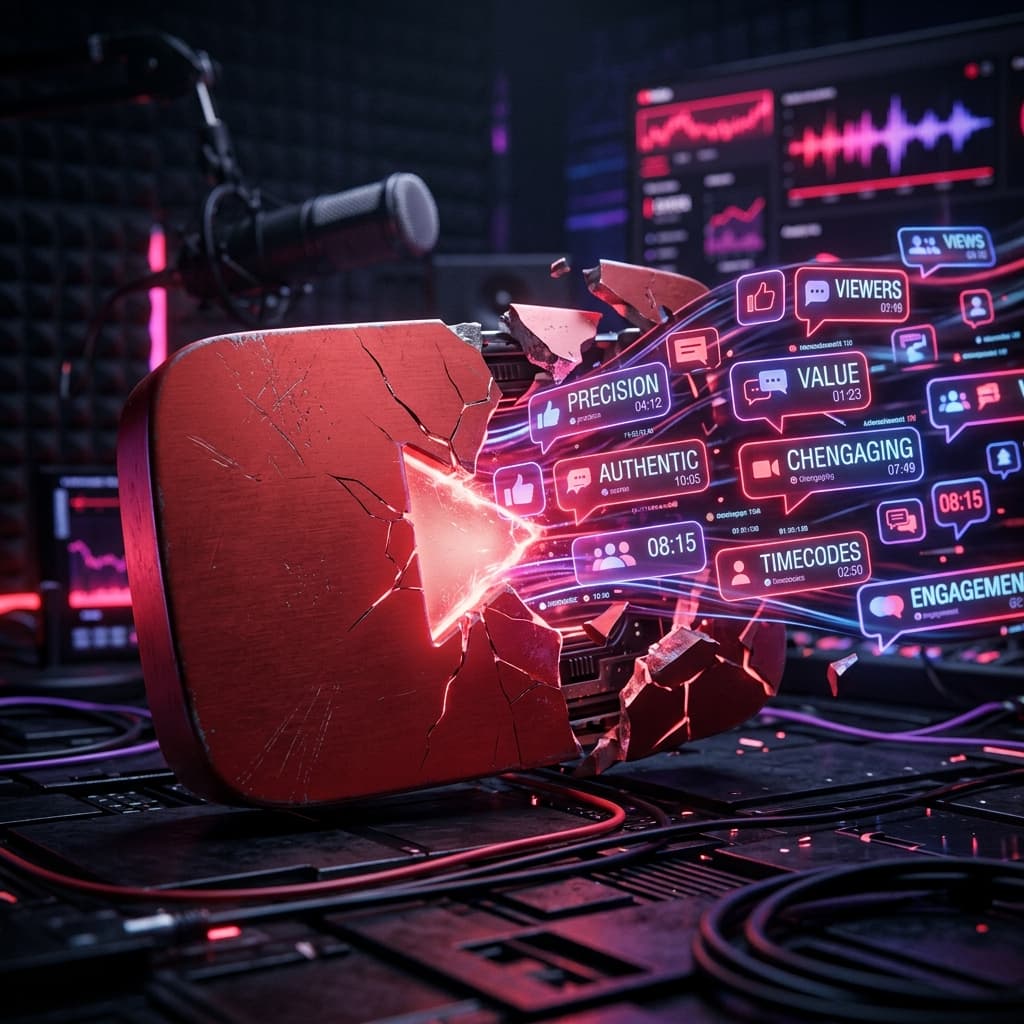
For creators, the most destabilizing aspect of Ask YouTube is its ability to skip the fluff. The AI parses automated video transcripts, visual cues, and chapter markers to point the user exactly to the 20-second window that solves their problem.
This creates an intense conflict between user utility and creator survival. YouTube’s monetization framework relies heavily on watch time and retention. If a viewer relies on AI to extract a snippet of your video on hover, get their answer, and leave, your retention graph falls off a cliff. Mid-roll ads are bypassed, viewer session lengths drop, and the financial incentive to create deep, exhaustive content begins to erode.
Furthermore, for music publishers and independent artists managing catalog distribution across video platforms, the traditional method of algorithmic recommendations is shifting. Instead of your ambient track or electronic mix being pushed to a user's home feed based on historical viewing habits, the AI will pull your track into a personalized response thread because the sonic profile or community description perfectly matches a highly specific mood requested via a voice prompt.
Opportunities: Moving from Clickbait to Contextual Authority
While the transition is bound to cause friction for creators relying on sensationalized hooks, the opportunities for high-value builders and niche curators are unprecedented.
1. The Era of "Semantic SEO"
Because the AI relies heavily on video transcripts to index content, your spoken words are now your primary SEO keywords. If you are explaining a technical concept, building a full-stack application, or walking through an audio engineering setup, clear, structured articulation matters infinitely more than a flashy thumbnail. The creators who win this shift will structure their video content like documentation—clean, modular, and easy for an AI agent to parse and cite.
2. Mood and Context Indexing for Audio Creators
For those distributing music, sound design, or atmospheric content, optimization is shifting from generic genres to contextual use-cases. Users searching for music through Ask YouTube are increasingly asking for tracks that fit hyper-specific operational profiles: "Give me a driving, syncopated electronic beat without heavy vocals for deep analytical work". Structuring your video tracks, titles, and automated captions around the utility and emotional landscape of the audio will make your work a prime target for AI citations.
3. Hyper-Targeted Micro-Audiences
Conversational search levels the playing field for smaller channels that possess deep domain expertise. A channel with a few hundred subscribers that provides the absolute clearest answer to a highly niche technical question can now be served as the primary cited answer ahead of a massive channel that only addresses the topic superficially within a broad 30-minute vlog.
The Playbook for Future YouTube Growth
To future-proof your digital content and maintain strong YouTube Growth as conversational search rolls out globally across web, mobile, and smart TVs, the execution strategy must adapt immediately:
- Front-Load the Value: Ditch the 90-second cinematic intros and long-winded channel updates. State the core thesis or deliver the value metric right away so that when the AI indexes your video, it finds high-density substance immediately.
- Design for Modular Chapters: Treat your videos like a collection of standalone components. Explicitly state transitions in your audio ("Now, let's look at how the vector database handles multi-modal data...") to ensure the automated transcription engine accurately segments your content.
- Optimize Your Verbal Metadata: Say your key terms out loud. If your video is about integrating next-generation developer platforms or publishing music through alternative distribution stacks, clearly speak those phrases within the first few minutes of the recording.
The conversational shift isn't going to kill independent content creation; it's simply raising the floor. The future of discovery belongs to the creators who stop trying to trick the algorithm and start focusing on delivering clear, hyper-contextual value that an AI can't help but cite.