Anyone who has ever spent a late night hunched over a development desk—specifically wrestling with an ESP32 microcontroller, debugging erratic Bluetooth packets, or trying to send a stable PWM (Pulse Width Modulation) signal to smooth out a twitching servo motor—knows a brutal truth about hardware: the physical world does not care about your clean software logic.
In pure software, if your code has a minor state mismatch, you throw an exception or reload the local runtime server. But in embedded systems and robotics, a single timing misalignment or a dropped Wi-Fi packet means your robotic arm overshoots its threshold, burns out a servo, or physically crashes into a wall. For years, this massive friction point kept the worlds of advanced artificial intelligence and physical automation completely isolated. We had brilliant large language models running in pristine cloud data centers, while our physical machines were still running on rigid, hardcoded C++ routines.
But in mid-2026, that historical barrier has completely shattered. We are living through the dawn of Physical AI—a tectonic shift where foundation models are moving out from behind our glass screens and stepping directly into the physical coordinates of our messy, unpredictable world.
The Technical Shift: From Rigid Automation to World Models
To understand why robotics is suddenly accelerating faster than anyone expected, you have to look at how the software driving these machines has evolved. Traditional robotics relied heavily on explicit instruction mapping. As developers, we had to write deterministic code telling a microcontroller exactly how many degrees to rotate a joint based on rigid sensor inputs.
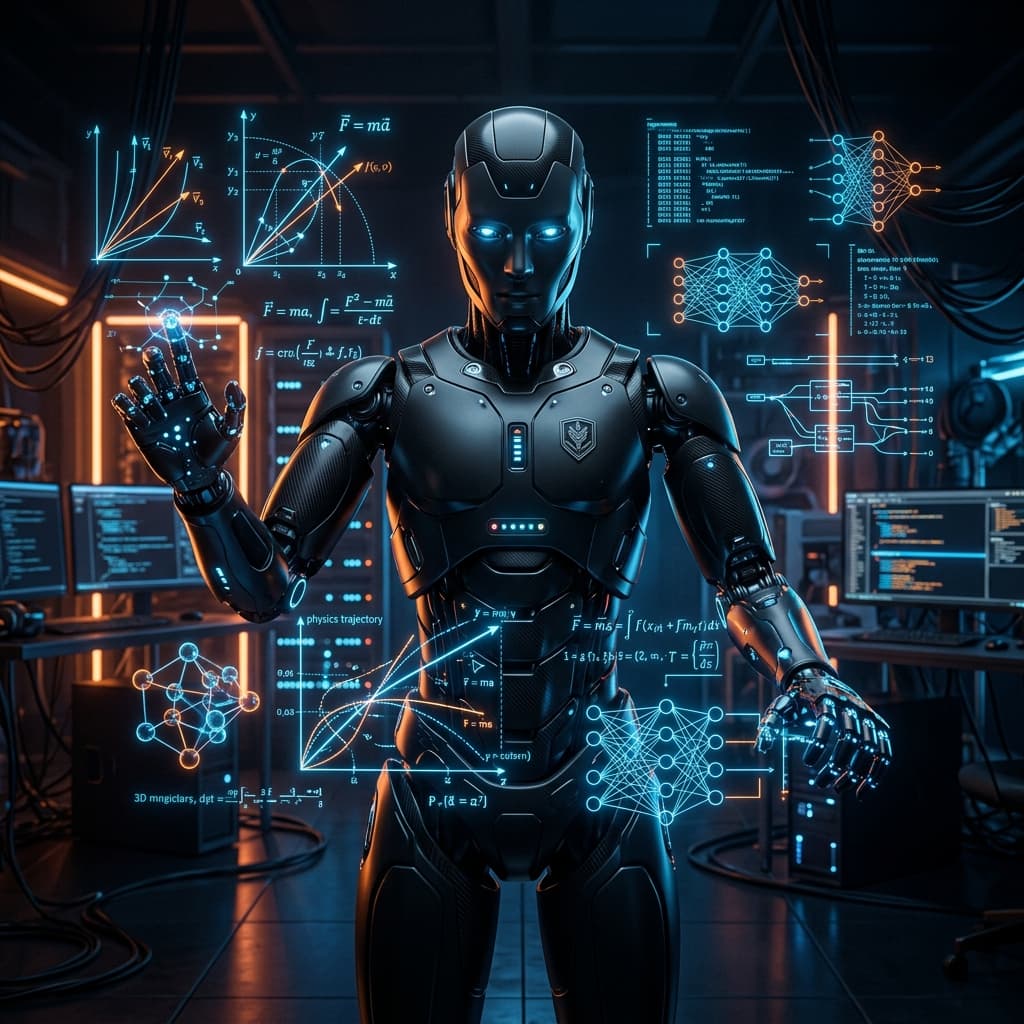
Physical AI completely inverts this approach via Vision-Language-Action (VLA) models. Instead of programming explicit, brittle mathematical rules, we pass multi-modal sensor streams directly into an end-to-end neural network that learns the direct mapping from visual observations to physical motor actions.
This structural evolution has ignited a fierce global race to build the ultimate embodied "brain". Just days after NVIDIA unveiled its massive Cosmos 3 world foundation model—engineered to let physical systems simulate and "think" about physics before they execute an action—a hyper-agile startup called Spirit AI took the top slot on the global RoboArena leaderboard with its Spirit v1.6 policy engine.
These models don't just process text; they process real-time spatial physics, depth fields, and tactile force feedback. They run continuous inner simulation loops to predict what the physical environment will look like a split-second into the future, allowing a machine to handle items it has never seen before with fluid, human-level dexterity.
The Ultimate Convergence: IT Meets OT
What makes this moment so unique for those of us studying AI systems and building full-stack applications is the massive acceleration of IT/OT convergence. Information Technology (the world of data processing, LLM APIs, and cloud scale) is merging directly into Operational Technology (the physical machinery, assembly loops, and edge industrial controllers on factory floors).
This intersection completely redefines the lifecycle of physical development. Instead of risking real-world hardware failures during early testing, developers are leveraging Sim-to-Real pipelines.
We instantiate thousands of identical virtual humanoids or robotic platforms inside physics-accurate digital twin environments like NVIDIA Isaac Sim, running them at accelerated cloud-compute speeds to master complex manipulation tasks through synthetic data generation. Once the neural policy hits a stable threshold in simulation, that weight checkpoint is compiled and flashed directly onto local edge superchips running on the machine.
The Real-World Pipeline: Scaling from Hobbyist to Architect
When you look at how these production-grade Physical AI stacks are architected, you realize that the core mental model isn't entirely different from the basic IoT projects we tinker with in the lab. The components have simply been supercharged by advanced cognitive layers:
-
Sensor Fusion and Ingestion: Real-time Data Streaming. Instead of a single ultrasonic or basic infrared sensor, you coordinate multiple RGBD cameras, tactile array gloves, and joint encoders streaming high-frequency positional data simultaneously.
-
Data Normalization and Curation: Cosmos Data Architecture. The multi-modal sensor inputs are processed through annotation and curation layers (like the Cosmos Curator reference architecture) to filter out background noise and extract clean spatial data vectors.
-
Policy Inference on Edge Silicon: Low-Latency Compute. The processed data is fed directly into a local, high-performance edge compute module (like a Jetson Blackwell unit) running a quantized VLA policy model, ensuring single-digit millisecond decision loops completely offline.
-
Actuator Translation and Execution: Dynamic Motor Action. The model's abstract probability outputs are converted back into high-precision micro-commands, driving high-torque servo motors and limbs to fluidly adapt grip force or balance parameters on the fly.
The Great Data Controversy: The Internet is Not Enough
Despite the staggering multi-billion dollar capital rounds pouring into startups like NEURA Robotics to build global Physical AI infrastructures, the entire movement faces a massive, structural bottleneck: the data scarcity crisis.
Large language models succeeded rapidly because they were able to scrape two decades of human-generated text, articles, and open source code directly from the web. But humans haven't spent the last twenty years uploading structured datasets of what it physically feels like to turn a rusty bolt, open a jammed doorway, or balance on a slippery floor.
| AI Domain | Core Data Source | Primary Bottleneck | Scaling Ceiling |
|---|---|---|---|
| Digital/Software AI | Public Web Text, Code Repositories, Synthetic Essays | Running out of unique, high-quality human text data. | Approaching asymptotic limits of public data availability. |
| Physical/Embodied AI | Real-World Teleoperation, High-Fidelity Physics Simulations | High hardware costs and slow manual demonstration collection. | Virtually infinite, bounded only by available simulation compute pipelines. |
This data asymmetry is forcing the tech giants to construct massive, industrial "Data Factories". They are hiring fleets of human operators wearing kinetic tracking suits to perform manual labor for thousands of hours just to record the tokenized muscle and visual inputs needed to train the baseline models. In this new paradigm, raw computing cycles are being transformed directly into high-fidelity physical training data.
The Opportunity: The Era of the System Optimizer
For any developer who has felt the creative spark of building localized automated systems, wiring up small microcontrollers, or setting up wireless communication loops, this transition is an absolute gold rush. The mechanical engineering problems of robotics are rapidly standardizing around open-source reference designs and modular hardware frames. The real differentiator now lies completely in the software architecture, model integration, and protocol efficiency.
The world doesn't just need people who know how to build a basic chassis; it desperately needs system architects who understand how to configure low-latency edge-to-cloud data loops, manage token pipelines, sandbox autonomous scripts, and map complex model boundaries so machines can safely interact with humans.
Stop treating your software experience as something confined to a web browser or a mobile screen. The physical world is opening up its source code. Learn how these multi-modal world models process spatial reality, understand the plumbing of edge data structures, and start building systems that can see, hear, and shape the physical world around us.
See the Tech in Action
To see exactly how these concepts are leaping from theoretical research labs straight into physical deployment, watch this live demonstration from the floor of NVIDIA GTC 2026:
Physical AI in Action at NVIDIA GTC 2026 | Humanoid Robotics Demo