For the past decade, the foundational rule of the consumer internet has been simple: There’s an app for that.
If you wanted to book a flight, order food, track your budget, or mix audio tracks, you downloaded a standalone package from an app store. You adjusted to its unique user interface, accepted its notifications, and let it occupy a piece of physical real estate on your screen. The goal of every software engineer was to build a beautiful, sticky frontend that kept users trapped inside their specific ecosystem.
But if the major announcements from Google I/O 2026 proved anything, it's that the era of app-centric computing is rapidly drawing to a close.
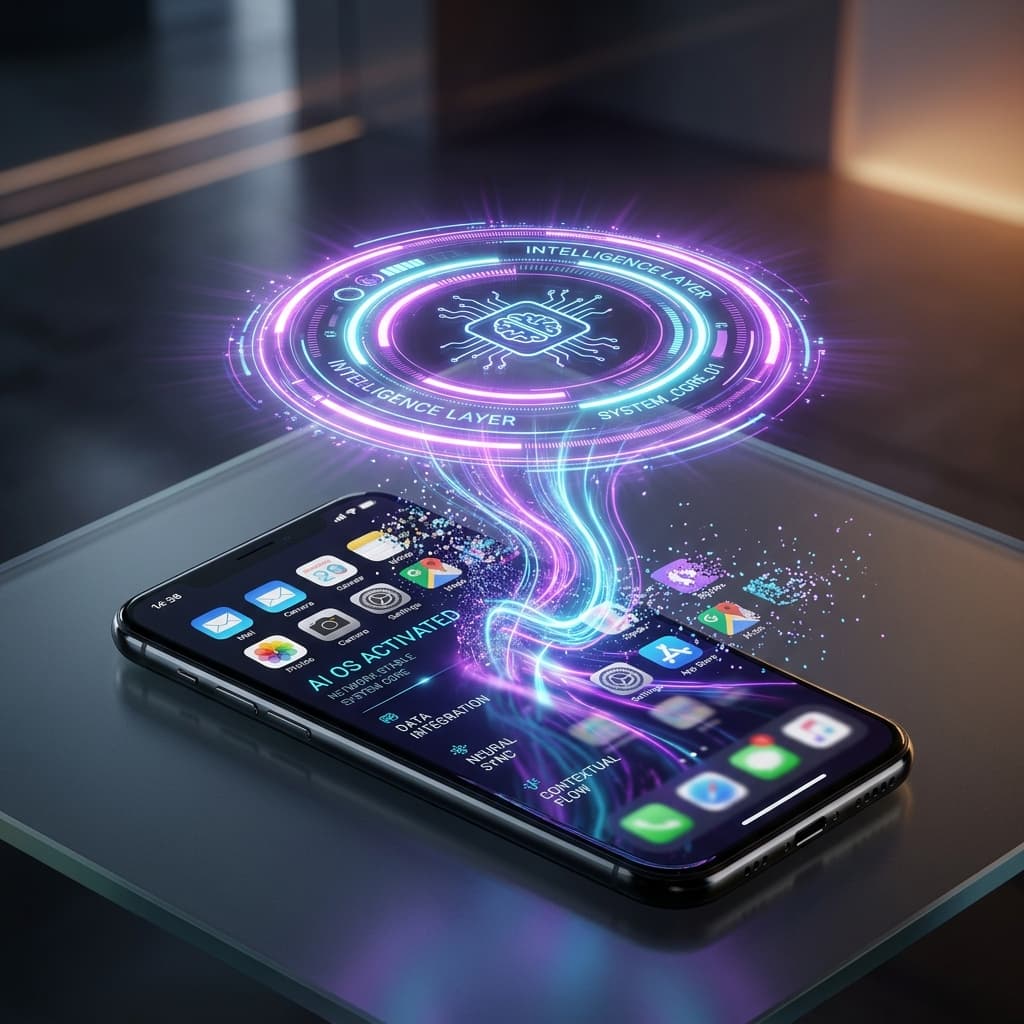
We are moving past the concept of software as a destination. With the unveiling of native, deeply integrated background agent systems like Gemini Spark and persistent on-device ambient interfaces like Android Halo, the operating system itself is becoming the only interface that matters. Users aren't going to open individual apps anymore; they are going to dictate an objective to an autonomous agent and let the background layer orchestrate the execution.
For anyone currently studying Artificial Intelligence or working in the trenches of full-stack web development, this isn't just an interesting trend. It is a complete architectural paradigm shift. It forces us to completely re-evaluate what it actually means to "build software."
The Android Halo Effect: Interface Liquidization
The traditional mobile app is a silo. It wraps data and logic inside a custom visual layer. To get something done, a human acts as the manual data-bridge—copying information from a calendar app, opening a ride-sharing app, pasting an address, and navigating a checkout funnel.
Features like Google’s Android Halo change this entirely by pulling the agent layer out into a persistent, system-wide ambient presence.
When an agent can run tasks silently in the background—handling multi-tab research, coordination, and updates without you ever launching a browser window or a specific app client—the app store ecosystem starts to dissolve. The browser and the OS are merging into a singular cognitive engine.
The Web Engineering Shift: From Layouts to Tool Registries
As full-stack developers, this shift fundamentally changes our relationship with the frontend. For years, massive amounts of engineering energy went into responsive web layouts, custom UI components, and complex frontend state management.
In an agent-dominated world, your primary user isn't a human clicking a button; it’s an AI agent invoking an endpoint.
Look at the introduction of open web standards like WebMCP (Model Context Protocol). WebMCP is specifically designed to let web developers expose structured JavaScript functions and HTML forms directly to browser-based AI agents.
The New Architecture: We aren't building visual interfaces to be looked at; we are building programmatic schemas to be consumed by agents.
If you build an automation app, a music publishing dashboard, or a localized service, success will no longer be measured by daily active users staring at your UI. It will be determined by how clean, reliable, and expressive your API endpoints are when an agent queries them.
| Dimension | The Frontend Era (Passing) | The Agentic Era (Emerging) |
|---|---|---|
| Primary Consumer | Human Eyes & Thumbs | LLM Orchestrators & Sub-agents |
| Core Design Target | UI/UX, Component Libraries, Visual Stickiness | Clean JSON Schemas, WebMCP Tool Integration |
| Monetization Gate | Ad Impressions, Paywalls, App Store Purchases | Value-based API Credit usage, Open Protocols |
| Transactional Standard | Manual Form Fields & Multi-step Clicks | Universal Cart Framework Integrations |
Consider Google's new Universal Cart framework, which allows AI agents to securely execute transactions across third-party merchant partners automatically. If your system cannot cleanly interface with a universal purchasing layer, your product effectively ceases to exist in the agentic commerce economy.
The Controversy: Who Survives the Invisible Web?
This evolution isn’t without severe controversy. The entire economic fabric of the independent creator economy and boutique software development is built on real estate. Apps monetize via visibility—app store rankings, display advertisements, premium UI upgrades, and direct user attention.
If a personal agent like Gemini Spark or an on-device operating assistant acts as a protective shield, summarizing content locally and executing transactions invisibly, how do independent developers survive?
- The Disappearance of Ad Revenue: If a user never visits your frontend because an agent fetched the raw data via a WebMCP hook, your ad inventory becomes worthless.
- Platform Hegemony: Giant gatekeepers control the central routing models. If their core orchestration engines decide to favor specific enterprise APIs over your independent application, smaller developers could be instantly cut off from traffic.
- The Loss of Brand Identity: When your software’s output is delivered to the user inside a generic system text bubble or an ambient notification space, your personal brand, custom design aesthetic, and unique visual identity are completely stripped away.
The Opportunity: System Architects Win
While this might sound alarming for traditional frontend engineers, it is an unbelievably exciting time for anyone specializing in AI and backend systems architecture. The death of standalone apps doesn't mean the death of software; it means software is shedding its skin.
The developers who win the next phase of the web will focus on building deep, bulletproof, highly specialized microservices. Instead of trying to build the next giant platform, the goal is to build the ultimate utility—a perfectly optimized data engine, a hyper-accurate machine learning pipeline, or an automation stack that handles edge-case tasks so flawlessly that no central AI agent can afford to ignore your API.
The future of software isn't about keeping users glued to a screen. It’s about building quiet, high-performance background systems that make the entire agentic ecosystem smarter, faster, and infinitely more capable.